Thursday, May 27, 2010

Raise High the Roof Beam, Carpenters and Seymour

Continuing my revisitation of J.D. Salinger, did I extract my Raise High the Roof Beam, Carpenters and Seymour, an Introduction from the shelf.

Raise High the Roof Beam, Carpenters unfolds in that brilliant way, revealing pieces bit by bit, including that marvelous title.

Seymour is exquisite and indulgent, a dream to read. For fans of the Glass family, and me reading these stories so close together, it, to borrow a phrase from The Dude, really ties the room together. Told from the perspective of Buddy, it's Buddy who tells us that he wrote many of the stories in Nine Stories, even those that don't have to do with the Glass family, like "Teddy". No less than a meditation on art and artist, "Buddy" writes some killer lines, like "When he was twenty-two, he had one special, not thin, sheaf of poems that looked very, very good to me, and I, who have never written a line longhand in my life without instantly visualizing it in eleven-point type, rather fractiously urged him to submit them for publication somewhere." and "You can't argue with someone who believes, or just passionately suspects, that the poet's function is not to write what he must write but rather, to write what he would write if his life depended on his taking responsibility for writing what he must in a style designed to shut out as few of his old librarians as humanly possible." Buddy bristles at the idea that Seymour's art is based on biography, that old saw that true art comes from the imagination - it's one I don't particularly believe in because I think it's generally used as a defense of art by men and a way to discard art by women, but I never get tired of the argument.

I'm waiting with baited breathe to hear if any more stories will be published. Rumor has it that he had piles of stories about the Glasses.

Sunday, May 16, 2010

The Plot Against America

In The Plot Against America, Philip Roth writes an alternate history to WWII in which, instead of going to war, America doesn't re-elect Franklin Roosevelt but instead Charles Lindberg, who becomes an ally of Hitler.

The story is told from the perspective of a young, Jewish boy in Newark whose parents view with immediate suspicion the change in leadership and the direction of the country. A family vacation to DC reveals the first public expressions of anti-semitism the family faces and soon after the oldest son is recruited to be part of a program to send young Jewish boys to the "heartland" to work on farms. He returns with less respect for his parents and deeply ingrained with the lessons he learned in "real America."

Mr. Mawhinney owned not just one farm but three--the lesser two rented to tenants - land that had been in his family going back nearly to the days of Daniel Boone, and my father owned nothing more impressive than a six-year-old car. Mr. Mawhinney could saddle a horse, drive a tractor, operate a thresher, ride a fertilizer drill, work a field as easily with a team of mules as with a team of oxen; he could rotate crops and manage hired men, both while and Negro; he could repair tools, sharpen plow points and mowers, put up fences, string barbed wire, raise chickens, dip sheep, de-horn cattle, slaughter pigs, smoke bacon, sugar-cure ham- and he had raised watermelons that were the sweetest and juiciest Sandy had ever eaten.

The anti-semitism grows stronger and stronger until eventually the US experiences something quite similar to Kristallnacht.

What Roth's book illustrates is how easily compliancy can lead to vast human rights violations. Published in 2004, it seems quite likely that the book was influenced by the liberties of the Bush administration, although I haven't read anything by Roth himself about that. For me, what really struck home, after some additional research, was the untold story of Charles Linderberg and other notable historical figures like Henry Ford, who are no less than national icons and symbols of all that is good about American ingenuity and capitalism, but were both anti-semites and used a fair amount of their political capital to promote that agenda. (There's a very helpful postscript in the paperback version that includes a "note to the Reader" and a "A True Chronology of the Major Figures" that provides more information.) Many of the hateful comments made by those characters in the book are taken directly from public speeches made by those men. (The postscripts reveals that history has literally been re-written in which re-publications of Lindberg's journals omit anti-semitical statements.)

Roth seems determined to expose Linderberg and Ford for the contributions of hate they added to the political and social atmosphere and I think that's a worthwhile endeavor. Ignoring their faults does a disservice to people who work for peace and, well, shows us that history is often a lie. And, of course, it is.

Aside from providing a lot of fodder for thought, the book is very entertaining and readable, as almost all of Roth's work is. I've never been disappointed by him with the exception of his 1971 Our Gang, which I think I just didn't have the historical perspective to appreciate. If you've never read Roth before, I'd suggest Goodbye, Columbus, which is one of my favorites - but, I certainly haven't read all of his stuff and would appreciate your suggestions if you have!

Sunday, May 02, 2010

Nine Stories

After re-reading J.D. Salinger's Franny and Zoe, I re-read Nine Stories as well. It begins with A Perfect Day for Bananafish, an at-first charming and mysterious and ultimately alarming little story about the eldest Glass child, Seymore, on a beach vacation with his wife. That story's shocking ending rather keeps the reader on their toes for the rest of the collection. I'm quite fond of The Laughing Man, about a young boy who idolizes this young man who's kind of like a boy scout leader that all the boys call the Chief.

I like how many of the stories have a little mystery that unravels, like Down at the Dinghy, in which the maid has said or done something she shouldn't have and doesn't become clear until the end. Or Teddy, the last story, about another young boy of preternatural intelligence or perhaps (no spoilers) something else? I think all the stories highlight Salinger's incredible skill in the realm of the short story, and how in a few short pages he creates such a rich landscape of history and language and suspense.

From Teddy:
"I have a very strong affinity for the them. They're my parents, I mean, and we're all part of each other's harmony and everything," Teddy said. "I want them to have a nice time while they're alive, because they like having a nice time... But they don't love me and Booper - that's my sister - that way. I mean they don't seem able to love us just the way we are. They don't seem able love us unless they can keep changing us a little bit. They love their reasons for loving us almost as much as they love us, and most of the time more. It's not so good, that way."

I mean, wow. You could just spend the next two weeks thinking about that handful of sentences, couldn't you?

Unnatural Death

I picked up a Dorothy Sayers' book in South Beach at a fine little book store on Lincoln Road. I'd heard her mentioned reverently on some of the various book blogs I read and I was not! Disappointed! The book I somewhat randomly selected from her series was Unnatural Death, first published in 1927. It features a Lord Peter Wimsey, this wealthy dude who's really great at solving mysteries. He's kind of like Jeeves and Wooster rolled into one person, with a little Sherlock Holmes (He likes comparing himself to Holmes, as a matter of fact.)

The mystery in question is the death of an older woman for whom there is no sign of foul play and yet Peter Wimsey has a suspicion that she was murdered and sets out to solve it. Apparently the book was quite topical when it was published, relating to a change in inheritance laws which caused me to recall Austen and even consider looking up the definition of an "entail." (Just to consider, not to do, ultimately.)

Well, I thought it was absolutely marvelous and I intend to read many many more books by Sayers. It's very British, very funny, very smart and kind of scary! (I got spooked at the end!) Here's a passage that made me laugh:

"Your friend's going to be left behind," said Mrs. Cropper as the train moved out."

"That would be very unlike him," replied Mr. Murbles, calmly unfolding a couple of rugs and exchanging his old-fashioned top-hat for a curious kind of travelling cap with flaps to it. Mrs. Cropper, in the midst of her anxiety, could not help wondering where in the world he had contrived to purchase this Victorian relic. As a matter of fact, Mr. Murbles' caps were specifically made to his own design by an exceedingly expensive West End hatter, who help Mr. Murbles in deep respect as a real gentleman of the old school.

Sunday, April 18, 2010

Night

Recently I had a desire to read something really excellent, so I went to my bookshelves and pulled out Nobel Peace Prize winning author Elie Wiesel's Night, which has been getting a lot of press since the the 2006 re-translation by Wiesel's wife, Marion, and a new preface. It's a slim volume of 120 pages but the weight on the soul is quite heavy.

Wiesel's novel, which was originally written in Yiddish and translated to French in 1958, is about his experience as a young Jewish boy from Transylvania who was sent to concentration camps (Auschwitz then Buchenwald) in 1944. Weisel and his father were immediately separated from his mother and sister after a harrowing train ride to the camp (the mother and the sister were killed immediately).

The book is hopeless and heart-wrenching and the fact that he survived at all is rather astounding. What Wiesel makes clear is that those who did survive were robbed of their humanity - he describes how his body sort of went on autopilot, as, starved and abused, he nevertheless was able to run and work for long periods. He describes how men killed each other for a piece of bread, and how, ultimately, he turned his back on his father for fear that he would be beaten himself. Wiesel's honesty about his own most shameful moments are, simply, agonizing to read. He is a brave, brave man to expose himself. However painful to read, his book is a gift. He writes in his preface:
For the survivor who chooses to testify, it is clear; his duty is to bear witness for the dead and the for the living. He has no right to deprive future generations of a past that belongs to our collective memory. To forget would be not only dangerous but offensive; to forget the dead would be akin to killing them a second time.

Saturday, April 17, 2010

The Harlot by the Side of the Road

The Harlot by the Side of the Road: Forbidden Tales of the Bible, by Jonathan Kirsch is not so much about "forbidden tales". They're tales that are right there in the bible (I went and looked up a couple of them on my own). But they're the stories that priests and pastors and Sunday School teachers don't dwell on or even approach because they don't fit into the common narrative of the judeo-christian faith.

I would imagine that most folks from a Christian background would be unfamiliar with the stories in the book (according to the author, Rabbis also avoid these stories). I was familiar with a few, only because of my Art History background and a possible penchant for incestuous scenes in previous centuries. For example, one of the stories that Kirsch illustrates is that of Lot and his daughters. Lot and his family, as some of you might know, lived in Soddam, a city which God destroyed but allowed this one family to escape. As they were leaving, Lot's wife "looked back" and was immediately turned into a pillar of salt. Lot and his daughters eventually ended up in an isolated place and thought that the whole population of the world was destroyed. So, the daughters had sex with Lot to repopulate the earth. Look it up. Genesis 19:31-38.
(Hendrick Goltzius, 1616)

Actually, from my own experience of growing up in a conservative Lutheran church, I remember very well the story of Lot and his wife, but I certainly don't remember being told the bit with the daughters. Our church was not the kind that entertained questions of any kind, so, "Why did his wife turn into SALT?" was the sort of thing that was answered with, "Why don't you sit there and be quiet?" And my family wonders why I don't want to go to church with them.

Kirsch copies various texts from the Bible, and then narrates it again for folks who have trouble parsing out the language. Then, he examines the history of the story and any cultural issues in the past or present that might apply. So, for the story of Lot and his daughters, he'll suggest that Lot, who was clearly not a righteous man, was more of a classic buffoon and the story would surely have "gripped the ancient reader." Oh, and I forgot the part where Lot offers his daughters to this angry mob of people to rape? That's because, Kirsch explains, the head of household must do absolutely anything he can to appease his "guests".

Kirsch's point, which he reiterates frequently, is that the bible is chock-full of these crazy stories which, in fact, do not carry a moral or didactic tale, but are simply entertaining and complex. "I hope to take back the Bible from the strict and censorious people who wave it in our faces and to restore it to the worldly man and woman who will appreciate the flesh-and-blood passions that are described in the Holy Scriptures." His approach is similar, but not as damning as Bart Ehrman's Misquoting Jesus, which challenges the idea that the Bible is the directly translated Word of God but rather just a bunch of made-up stuff that's been deliberately or casually mistranslated for hundreds of years. Ehrman ultimately rejects the bible completely, which is not what happens to Kirsch at all.

I thought the book was really well-put together. I usually read a chapter, then was like, "No way." and then I'd go look it up in my own dusty Bible, then I'd tell my husband, then I'd read another chapter. Kirsch refers to a bunch of feminist Bible scholars (I didn't even know there was such a thing!) that I'd like to check out as well.

So we might conclude from an open-eyed reading of the forbidden texts of the Bible that the fundamental truth is that there is no fundamental truth. Instead, we are invited to join the rest of humanity in a restless, ceaseless search to discern some moral order in a chaotic universe. We are challenged by the Bible itself to figure out who God is and what God wants - and that is the most disturbing revelation of all.

Abundance

Abundance: A Novel by Marie Antoinette, by Sena Jeter Nasland is historical fiction about (you guessed it) Marie Antoinette. It's extremely well-researched and includes, as far as this semi-M.A.-dabbler can tell, just about every real-life quote that's documented by the former queen of France, and major historical details from the Necklace Scandal to, natch, the French Revolution. It's also the book upon which Sophia Coppola based her 2006 movie, Marie Antoinette (my review).

Jeter Naslund is a poetic writer, given to long flourishes, which are really fun at first but get old after a while. I also read (most of) her Ahab's Wife about (you guessed it...) but didn't finish it. In fact, I didn't finish Abundance but ended up skipping large portions of it. I was interested in how she wrote The End, which, I think I do not have to avoid spoilers here - suffice to say that The End is rather startling and beautiful - what she creates is an image of a young woman who's been raised her entire life to appease and to charm, to make herself amenable and that's what she does right up until her head gets removed from her body.

Saturday, March 27, 2010

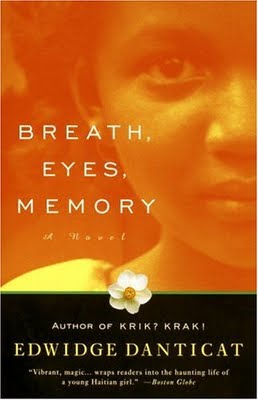
Breathe, Eyes, Memory

Breathe, Eyes, Memory is by Haitian author, Edwidge Danticat, 1998. I first learned about Danticat on the New Yorker Fiction podcast. Danticat read a story by Junot Diaz, and later, Diaz read one of her stories. Diaz spoke so highly of Danticat that his recommendation was enough for me.

Breathe, Eyes, Memory is a book about a young girl, Sophie, who lives with her aunt in Haiti. Her mother lives in New York and soon sends for her. She lives with her mother for a little while, and then there's a quick fast forward when Sophie returns to Haiti with her own daughter to deal with some family issues. (I don't think I'm ruining it for you.)

Danticat weaves in some big themes: diaspora, the abuse cycle, sexuality, family, matriarchy. Her description of life in Haiti is both beautiful and sometimes a bit shocking. Sophie's mother begins what she calls "testing" her in an attempt to verify her virginity. Sophie realizes this is a pervasive practice in her culture and comes up with a fairly drastic way to make it stop. She hates the practice and suffers psychological repercussions, as did her mother, and as did her mother.
Haitian men, they insist that their women are virgins and have their ten fingers.

According to Tante Antie, each finger had a purpose. It was the way she had been taught to prepare herself to become a woman. Mothering. Boiling. Loving. Baking. Nursing. Frying. Healing. Washing. Ironing. Scrubbing. It wasn't her fualth, she said. Her ten fingers had been anmed for her even before she was born. Sometimes, she even wished she had six fingers on each hand so she could have two left for herself.
Something that surprised me is that Danticat's writing is extremely simple. Aside from the somewhat frequent multilingual text, I was generally not wow-ed by her writing, although I appreciate how extremely accessible it was, and think this would be a really excellent book for young women. I remember Diaz saying that the way she writes is actually a rather complex accomplishment for a writer, I'm not sure I get that, but I really respect his opinion. The last two pages, I will say, were absolutely beautifully written, and I suspect the simplicity of the language for the majority of the book made those last few pages all the more spectacular.

Tuesday, March 16, 2010

Franny and Zooey

After JD Salinger died, I got that old familiar craving to read The Catcher in the Rye (for the __ time?) and, horror, it was not on my shelf. But there was Franny and Zooey, which I haven't read for quite a while. Dave Eggers wrote a lovely bit in the New Yorker re: the influence of JD Salinger, which almost goes without saying for a person like Eggers, forgoodnesssakes. These parts struck me:
I read “The Catcher in the Rye” the average number of times for a young person my age—which is to say, every few years between when I was sixteen and twenty-six or so.
Hey, meeee tooooo!!!!
His is still my favorite dialogue, the dialogue that rings truest, that’s at once very naturalistic and musical; it’s really remarkable how difficult it is to do what he does between quotation marks.

I think what's really interesting about his dialogue is, take for example, our Holden Caulfield - his language is pretty dated, but it remains so immensely readable! But, that sentence really made me want to go back and read Salinger with a more critical eye.

After he died I read that Salinger became a Buddhist as well as a semi-reclusive, so it was with only a small amount of surprise to rediscover (me and my memory!) Franny (the first of two short stories in the slender 1961 book) is about a young woman practicing Buddhist-style mediation with a Christian prayer. What I found remarkable about the story, as I read it again, was what brilliant control Salinger had over the narrative structure (and yes, that delicious dialogue) and in no more than 44 pages we learn so much about the characters. Zooey continues the arch and further examines (I don't think I'm ruining it for you...) the act of the repetition of the Jesus Prayer and delves even further into the marvelous Glass family. I found the both stories near-transcendent, they were so beautifully crafted and told.

And what really struck me, as I re-read these stories, was how much Salinger and one of my other favorite childhood books, From the Mixed-up Files of Mrs. Basil E. Frankweiler by E. L. Konigsburg inspired me for a life of arts, literature, and, dare I say it? Sophistication and education (me and Wes Anderson, right?) And to live in NY, which A Certain Husband continues to resist...

Saturday, March 13, 2010

Unnatural Causes

Now I can't seem to resist picking up a P.D. James book when I see one, despite the fact that she and I have a tumultuous relationship. But, I'm beginning to think that if I feel like reading a decent British mystery, she's my gal. I think.

Unnatural Causes features Adam Dalgliesh, her steadfast detective, who, Murder She Wrote-style, goes on what he thinks will be a relaxing vacation to visit his aunt when a murder changes his plans. The suspects are the denizens of aunt's tiny sea-side village and for some reason they all start behaving like suspects right away, spilling the beans about their alibis to anyone who will listen.

I thought it was a decent little mystery that kept me guessing - by coincidence I happened to watch Murder on the Orient Express, by another acknowledged queen of mystery-writing and thus went through several They ALL Did It! moments.
James is a clever writer and a good one. Here's a passage that made me laugh and also sent me to the dictionary (I LOVE being sent to the dictionary, don't you?):
...The exclusion of women means that some of the best crime writers are unrepresented but this worries no one; the Committee take the view that their presence would hardly compensate for the expense of putting in a second set of lavoratories. The plumbing at the Cadaver has, in fact, remained virtually unaltered since the Club moved to Tavistock Square in 1900 but it is a canard that the baths were originally purchased by George Joseph Smith.

I was all, canard? Isn't that a duck?

James's 1967 book is a bit dated with an oogy reference or two to "colored people" and some 1960's pre-PC references to a "cripple". Blech.

Thursday, March 04, 2010

Lonely Werewolf Girl

Lonely Werewolf Girl was published in the UK in 2007, and somehow escaped my notice until fairly recently. Needless to say, it was quickly rectified. It's written by Martin Millar, who's supposedly agoraphobic (what a coincidence!) and the book is self-published, which is pretty cool considering its success.

Lonely Werewolf Girl is categorized as a YA book and, in fact, I picked it up in the YA section of my fave Chicago book store, Women and Children First. I'm not sure it's exactly a book for teenagers or kids. Then I started thinking about how someone recently called me an "adult" and I got sort of surprised. So, I started thinking, "Am I not a young... adult?" Is it possible that all this time YA books are literally meant for Young Adults like me, dopey ladies in their 30s?

As you might suspect, Lonely Werewolf Girl is about this girl (14 yrs old), who's a werewolf (born one). She's not only lonely, a bit of rogue, but she's bulimic, suicidal, nearly illiterate, drug-addicted, and a cutter. Lonely werewolf girl isn't really the main character, even though most of the story circles around her. The most relate-able characters are a couple of humans who get involved in the plots and schemes of all these werewolves and folks from different dimensions and whatnot. The non-humans are mostly unpleasant and have bad personalities, not being bound by the social norms that most of us humans ascribe to (which is fodder for someone else's web post).

The book draws inevitable comparisons to Twilight, which I am powerless to avoid. Like Twilight, one of the main characters has an extremely unpleasant personality who makes you wonder, "Am I seriously supposed to feel SYMPATHETIC toward this girl????" And it's about a bunch of nonsense creatures that walk around in the modern world talking on their cell phones and having star-crossed love and being ridiculously moody. About 20 pages in, I thought, if this is some more uptight, sexless Twilight bullshit, I'm OUT. And then:
Gawain was the most handsome of werewolves, and he had once been her lover. On her fourteenth birthday she'd crept into his bed at Castle MacRinnalch and after that they were never out of each other's company. They had a year of insane joy before he was banished. Kalix yearned to see him again, but she knew he was never coming back.

OK, then. Unlike the Twilight series, it's very funny, it's progressive (pro-cross-dressing!), and, unlike Twilight, it isn't written so badly you curse the author for destroying the English language for you.

At 558 pages, I thought it was a bit long, although, I really enjoyed reading it and when I was stressed out at work I daydreamed about laying on a beach reading this book all day. I also think the author doesn't write women very well - it was as if he thought to himself, "Hmmm... what are girls into? Clothes, and shopping! And big, clunky shoes!" So. There's that. But.

Guess what? There's a sequel coming soon.

Wednesday, February 24, 2010

Generation A

We read Generation A for book club. It's the latest by Douglas Coupland.

It's about these people that get stung by a bee, and it takes place in the not-so-distant future where bees are thought to be extinct. After these five folks get stung, they get quickly gathered up by scientists and taken in for observation and to find out if there's something special about them that attracts bees.

There are five main characters and some of them are kind of interesting - a young man from Sri Lanka who works at a call center for Abercrombie & Fitch and has an idealized view of Americans (in stylish, cotton clothing) mostly named "Craig". A young woman with Tourette's Syndrome. A corn farmer/pornographer. The others kind of merged into one person for me - but others in book club said they found them all quite distinct.
In Sri Lanka, a dog in a doghouse owned more than I did. Could I ever be a Craig? No. A person was born into Craigdom, with its multiple ski holidays, complex orthodontia, proper nutrition and casual, healthy view of recreational sex.

Without giving too much of the plot away, they all do have something in common, and ultimately what emerges (I don't think this will ruin it for you) is how, despite living in the digital age and all it's presumed alienation, we're (some of us) nevertheless more in touch with each other than we ever were before.

Coupland's book was a little disappointing only because I think he skirts closely to some rather profound thoughts, but doesn't commit to them. I wish his book had been a lot more challenging. Instead he seems to opt for a more pop sensibility which certainly lends an equanimous readability to the work, but it's also a kind of cop-out to the audience.

One bit I loved, however, was how Coupland played a little bit with language and text - check this out - can you read it?
Wondering where that title came from? Coupland is partly responsible for the popularity of the term "Generation X", as you may know. But Gen A is slightly different, and, if you ask me, this book will most assuredly not carry the same caché and come to define a generation as X did. It comes from Kurt Vonnegut:
"Now you young twerps want a new name for your generation? Probably not, you just want jobs, right? Well, the media do us all such tremendous favors when they call you Generation X, right? Two clicks from the very end of the alphabet. I hereby declare you Generation A, as much at the beginning of a series of astonishing triumphs and failures as Adam and Eve were so long ago."

Thursday, February 11, 2010

Snuff

So, I just finished this book by Douglas Coupland (Generation A) that I'll write about in a few days. After I finished it, I thought, gee, Coupland's kind of like Augusten Burroughs or Chuck Palahniuk although maybe not as creative and not as frantic. As if to prove it to myself, I picked up Snuff by Palahniuk.

A few years ago a friend said they saw Palahniuk read and said more than one person fainted at the reading because it was so shocking. Can you imagine, getting the vapors in this day and age? Anyway, this book is kind of like that - like, if you're reading it in a public place, you might find yourself holding the book half-closed so no one peeks over your shoulder and says OHMYGODWHATAREYOUREADING?

It's about a group of people who are waiting for their scene in a 600 person porn film gang bang to take place. And it's crazy-graphic and not for the faint of heart. I think what makes the book rather fascinating is that Palahniuk intersperses a healthy dose of thoughtful examination into the creation and participation of porn, and also into the extremes of ... shall we say... acting. Because, if you consider, for example, that the creation of a porn movie is not unlike the creation of any movie that requires the actor to go to some extreme lengths to portray his or her character, then you could conclude that porn actors and actresses simply go quite a far way for their craft. Palahniuk cites a number of examples of mainstream actors who go to such extreme lengths, a well-known example being the actor who played the Tin Man in The Wizard of Oz who suffered quite a bit from the metallic paint his character required.

By chance, a certain husband rented a movie, a very famous and influential 1976 Franco-Japanese film (from Netflix, fyi) called The Realm of the Senses which was pretty much straight-up porn, although fairly gorgeous, art-house porn full of all the things you hope to find in mainstream movies and have no expectations for at all in porn - like good lighting and characterization and beautiful sets and a nice storyline. There's also excellent, highly intellectual socio- and cultural analyses in the blu-ray commentary by scholar Tony Rayns who explains that the actors were actually mainstream actors who happened to go to extreme lengths (all the way) (get it?) for their roles.

I think Palahniuk is a very smart, very clever writer who's extremely compelling and really exciting to read. If you're a Palahniuk fan, you'll probably enjoy this book, but I otherwise wouldn't recommend it unless you consider yourself to be Outrageously Open-minded or really like porn titles like, you know, The Wizard of Ass, of which it is chock-a-block.

Thursday, February 04, 2010

Wuthering Heights

So, I read Wuthering Heights when I was a kid - I was a real Brontë-head back in middle school/high school and read Jane Eyre a perhaps excessive number of times. I read Wuthering Heights once or twice but I have a terrible memory and really couldn't remember a thing about it.

EXCEPT, I had this vague recollection that Heathcliff was a romantic, if broody, somewhat recalcitrant character. So, it was with no small amount of excitement that I began reading Wuthering Heights again, as if for the first time. And, it was very amusing and clever and mysterious and dark. I kept wondering, when does the romance start?

I'll remind you how the story goes in case your memory is as bad as mine: the year: 1801. Mr Lockwood rents a house from Heathcliff, who lives in the house next door, Wuthering Heights. Heathcliff is extremely rude company and lives with this weird gaggle of unhappy people. Upon spending the night at Wuthering Heights, Lockwood hears nothing less than a ghost outside his window, Catherine, who tries to grab him through the window and he cuts her and blood gets all over the place and everything. Lockwood freaks out, Heathcliff calls out to Catherine, "Come back to me!" or something and Lockwood splits.

Back at his rental, he gets the whole story from his maid how Catherine grew up in Wuthering Heights with her brother, and one day her dad brought home this "gypsy", and they named him Heathcliff. Catherine and Heathcliff were bosom pals, and probably would have gotten married one day, except for some reason Catherine married her cousin who lived in the rental. Only back then it wasn't a rental. Heathcliff doesn't take that well, and basically enlists on a long campaign of revenge that destroys everything everyone ever loved or knew. Among the terrible things he does is beat the hell out of people, practice child abuse, kidnap, force two women into unwanted marriages so that he'll control their property, kills at least one person, and also hangs a dog.

Why I had the impression that the story was romantic, I'll never know. It's really quite disturbing that it has that reputation. But, I did think that Emily Brontë, like Jane Austen, makes a powerful social commentary on the detriment of England's property laws as effected women. Women could own or inherit nothing, so they were under extreme pressure to marry well (as we see in Austin) and completely at the mercy of either husband or father (as we see in E. Brontë). Heathcliff first hoodwinks Catherine's sister in-law into marrying him and she is completely without power to divorce while he takes over her property, and later, he forces Catherine's own child (also named Catherine) to marry his child (in order to gain more property.) She also is unable to divorce.

I think Brontë wove a very clever Gothic ghost tail, and, for the most part, I couldn't put it down. During a dull bit in the middle, I tried to imagine myself reading it in the mid-nineteenth century with no tv! No Internet! No Sudoku, even! Probably if I was sitting around, reading Wuthering Heights out loud with my husband every night, I would have been pretty enthralled. And, we would have gone to bed feeling pretty smug about our relationship.

Of course, we always do that. We're no Heathcliff and Catherine.

Wednesday, January 27, 2010

Ice Haven

Ice Haven is a graphic novel by Daniel Clowes. I like Clowes style of illustration, and the story is as meta as I've ever read in a comic book. Clowes, who I believe is from the Chicago area, refers heavily to the story of Leopold and Loeb - a grim and awful tale of these two kids from University of Chicago who kill someone for basically no reason. The story parallels the tale of L&L, while the entire book is bracketed by the narrative of a comic book (or graphic novel) critic whom Clowes both mocks and elevates, by making him ridiculously self-absorbed and ass-scratching while at the same time allowing the "critic" to remind the reader of the greater themes of the book. Finally the critic explores Clowes biography for "evidence" of the author's worldview, thus providing a rather humorous bio of suspect veracity (at least to me) while continuing to mock the critic for assuming the artist's bio influences the work. Which leads the reader to consider whether it might... Very clever.

Sunday, January 17, 2010

Why Beautiful People Have More Daughters

At our book club meeting for this book, someone had a great idea to go around and say what we hated the most about the book. The funniest answer was - the subtitle: From Dating, Shopping, and Praying to Going to War and Becoming a Billionaire - Two Evolutionary Psychologists Explain Why We Do What We Do.

I actually hated this book so much I can't bare to write much about it, aside from saying Evolutionary Psychology seems to be a new and suspect field in which "scientists" claim that basically, everything we do is motivated by the urge to spread our seed, as it were. Of course, it's a ridiculous argument and there are like, four THOUSAND reasons it's ridiculous.

I'd go so far as to say that this book is dangerous and could easily inspire racism and sexism while excusing inexcusable behavior by claiming that the offender is merely following his natural, biological impulses. One of my friends said, "That book makes me angry beyond words. I would like to hunt down the author and punch him in the face." Me too! Not only that, but a room-full of librarians, book lovers and liberals agreed we'd all like to go out in the street and burn every copy we could get our hands on.

I would never suggest you read this book unless you enjoy being outraged.

Saturday, January 09, 2010

Enormous Changes at the Last Minute


I learned about Grace Paley from Selected Shorts, a podcast I listen to and admire. It's nice to hear her stories read, and read well. I probably should have tried reading some of the stories in this collection out-loud.

Paley's short stories are beautifully written - modern, witty, very American (American immigrant), feminist. Here's an example of a killer opening:
I saw my ex-husband in the street. I was sitting on the steps of the new library.

Hello, my life, I said. We had once been married for twenty-seven years, so I felt justified.

He said, What? What life? No life of mine.

I said, O.K. I don't argue when there's real disagreement. I got up and went into the library to see how much I owed them.

The librarian said $32 even and you've owed it for eighteen years. I didn't deny anything.

Although I found myself emotionally distant from most of her characters, sometimes they crashed right into my world:
Alexandra, in the first summer dress of spring, stood still and watched. She breathed deeply because of having been alone for a year or two. She put her two hands over her ribs to hold her heart in place and also out of modesty to quiet its immodest thud. Then they went to bed in the bedroom and made love until that noisy disturbance ended. She couldn't hear one interior sound. Therefore they slept.

The Girl with the Dragon Tattoo

Somewhat ambitiously, I took four books on our nine day Christmas vacation. Long days in a wintery cabin were spent not reading, however, but snuggling on couch with sister and staring adoringly at beloved nephew with husband. Therefore I only read one book, which I started on the airplane out and finished on the airplane in: The Girl with the Dragon Tattoo, by Stieg Larsson. It's a mystery story that takes place in Sweden. It's a translation, so that may account for what frequently comes off as stilted language.

It's a "page turner", as they say, in the grand tradition of the Dan Browns and Michael Connellys of this world, and of about the same literary merit. It's about a journalist, Mikael Blomkvist, who gets hired by a wealthy business owner to unravel a decades-old family secret. Along the way, a young woman, Lisbeth Salander, becomes involved. She's something of a private investigator and has some unexplained mental condition and social conditioning that leaves her with a different set of moral and ethical values than most of world generally agrees on.

Each section of the book begins with a quote like, "Forty-six percent of the women in Sweden have been subjected to violence by a man." Lending an ostensibly pro-woman, anti-violence theme to the book. The fact that the book glorifies violence toward women in its graphic exploration of the same theme is a bit problematic, to say the least.

I love reading books about different cultures, but this book reads as if the story were in any generic place, only all the places have Swedish names. So, it's not unusual to read a sentence like, "She took the tunnelbana from Zinkensdamm to Östermalmstorg and walked down towards Strandvägen." Also, apparently in Sweden there is a statute of limitations on murder.

I wouldn't recommend this book unless you happen to really love murder mysteries. The author was obviously a huge fan of the genre himself and frequently his characters pick up a book by Sue Grafton or the like for some casual reading. I'm vaguely interested in learning more about Lisbeth, but not enough to read the other books in the series. I'm sure there will be a movie soon enough.

Sunday, January 03, 2010

Year in Review: 2009

Last year I started keeping some stats of the books I've read so now I've got charts and everything! Here's how 2009 looked!

Books I read in 2009
Fiction: 34
Non-Fiction: 10
Books by Women: 29
Books by Men: 15

Comparison to 2008Good, my numbers have gone up, and up is always good, right? (That's what they tell me at work, anyway.)

Can you imagine what my chart would look like if I take my own challenge one year and only read one book, over and over? (Middlemarch.)

My favorites of 2009
A Gate at the Stairs
Push
Olive Kitteridge
Pride and Prejudice
Payback
Watch Your Mouth
The Year of the Flood


Happy Reading in 2010!

Thursday, December 17, 2009

Points of View

Points of View (1956) is an anthology of short stories I've had at my bedside for about a year now. The stories are arranged by point of view - Interior Monologue, Dramatic Monologue, Diary Narration, Subjective Narration, etc, which will prove uninteresting for those of us who have been reading for a while but might be interesting for young readers. There are, nevertheless, a few great short stories in it - A And P, by John Updike, which improves with every reading - really fantastic story about a young man working at the A And P in a tourist town. The eery The Lottery, by Shirley Jackson, which I just heard for the first time myself on one of my podcasts (I forget, either New Yorker: Fiction or Selected Shorts, both are terrific and you should subscribe if you haven't already. I like to listen to them at night if I'm too tired to read with my eyes.) Jackson's story sticks with you long after you wish you had forgotten it!

I'd been reminded of Flowers for Algernon recently when I read Push. Rereading Daniel Keyes's story confirmed for me that there are some similarities in the two stories, although, of course, Precious is responsible for her own growing knowledge, not some artificial means.

I wouldn't necessarily recommend this particular anthology, but I do love some of these classic short stories.