Tuesday, July 10, 2012

Year of the Gadfly

I reviewed this book for Newcity: The Year of the Gadfly, by Jennifer Miller. Here's my review. I also painted a scene from it!  Here's the inspiration text:
  Hazel opened the door wearing a long brown sweater, a thick green scarf, and at least a dozen jangling bracelets. She ushered them into to a large room with three tapestry-covered couches and skylights filtering snowy light. The room contained many large paintings, most displaying women in various states of undress. The canvas of the fireplace shoed a woman who resembled Hazel, minus the freckles. Her hair curled like vines across her naked breasts.

I thought I had completely ruined this one several times.  My darling husband, M, kept saying in a soothing voice, "There are no mistakes..." channelling Bob Ross. And later, Walter: "Nothing is fucked, Dude."  Hair, man.  It turns out hair is really hard.  I'm going to try to avoid it in the future.  There were a few "happy accidents" though.  In the end, I kind of like how her hair came out, although I had many small temper tantrums along the way.  I'm pretty happy with the neck, nose, and eyebrows, too.  The background is not great, obs.  

Saturday, July 07, 2012

The Orange Fish

Here's another watercolor from my not-quite-famous-yet (for some reason?) series based on things I'm reading.  This one's from a book of short stories by Carol Shields called The Orange Fish. The title is from the name of the first story, which is about a couple whose lives have gotten kind of stale, so they decide to buy some art work.  They buy a print of a goldfish in a bowl, and... well, their lives start to change.  It's a pretty incredible story.  I don't think my painting will ruin anything for you.

Here's the accompanying text:  Lois-Ann and I took in the flare of dyed hair, curiously angled and distinctively punk in style.  You can imagine our surprise: here of all places to find a spiked bracelet, black nails, cheeks outlined in blue paint, and a forehead tattooed with the world's most familiar expletive. 

I'm sort of proud of this painting, I mean, yes, overall it has some problems but some parts did what I wanted them to do.  I have another painting for you later in the week!

Friday, July 06, 2012

A Nobel Radiance

A chatty bookseller in Seattle talked me (easily) into buying A Nobel Radiance by Donna Leon.  I love a good mystery.  I guess this one is from a series about Guido Brunetti.  He's a "commissario" in Venice.  In A Nobel Radiance, Brunetti is trying to solve the mystery of a kidnapping that occurred a few years ago, after a body is found.  Brunetti is married to a woman who comes from an old, wealthy Venetian family - Leon has a nice balance between her main character's professional and personal life.

I must say, the ending kind of took me by surprise - I did not see it coming (always kind of a fun experience).  The only odd thing about the book was it really could have taken place anywhere. Venice was not really featured at all, which I thought was strange.  Why set a novel in an amazing city like Venice and then not play it up?  Leon seems like a very understated writer, though.  I think she might like putting her action in the wings.  Most of the action is extremely even tempered.

One thing I did love was how much Italian she slid in, without translations, but easily understood.  Except for this sentence: "Qualche garbuglio si troverà." Ah, turns out it's from Figaro... "I'll find some way to mess it up." It was also written in 1998, with a healthy dose of internet/computer skepticism. "Before Signorina Elettra, newly appalled at his ignorance, could begin to explain to him just what a modem was and how it worked, Brunetti turned and left her office. Neither viewed his precipitate departure as a lost opportunity for the advancement of human understanding."

I'd be interested in reading more of her work - if anyone is familiar with her books, please let me know.

Thursday, June 28, 2012

The Weird Sisters

I read about half of The Weird Sisters by Eleanor Brown.  I really love the concept - three literary sisters (named Rosalind, Bianca and Cordelia) whose parents were Shakespearean scholars.  The three sisters return to the little college town where their parents (or maybe just their dad? I can't remember) live, slipping back into their roles.  What really drove me nuts about the book, and why I ultimately didn't finish it, was that it felt SO PREDICTABLE.  It was a great idea, and I think Brown's a good writer - I loved the historical and literate references, but the inevitable slog toward the sisters bonding together to help each other overcome some conflict, pairing off with the various handsome, rugged men and their pick up trucks in town was too boring.

The book has a lot to do with birth order, which I suspect my sister would like.  She told me this is one of her friends fave books of the year, so, you know.  One person's trash.
Rose is the only one who can get us out the door on time when we have theater tickets or are trying to get to church services.  When our mother left pans of carrots boiling away to charred messes on the stove, Rose made us peanut butter and jelly sandwiches, cutting them neatly in sailboats for Cordy. When she got her driver's license, she drove Bean to the nearest mall (which isn't really near at all) almost every weekend night, and didn't even tell on her the time she met those boys with the Trans Am and came home with vodka on her breathe and vomit down the front of her blouse.... as much as she hates us for taking away her throne, she has never ever pushed us off of it.  And she would be none of those things if she weren't the firstborn.
If I'm wrong about the end, by all means, correct me!  For some reason, I find it quite difficult to "cheat" and skip to the end to see what actually happened.

Notice:  I have a new painting for my series!  I'll post soon.


Sunday, June 24, 2012

2nd in a series

I continue my (extremely slow) series of drawings created from books I'm reading.  Here's the first one I did, from Super Sad True Love Story.   This one I started a long time ago - inspired by Crossed, by Ally Condie.  The first watercolor was so bad, I wanted to redo it.  Here's the first one:
Terrible, right?
and here's the second one.   It still didn't come out exactly like I wanted, but I kind of like it.  

 Since I have like, absolutely no idea what I'm doing, I consider this all "win."  I don't think it would ruin the book to view this image, but, if you've read it, maybe you'll remember this part?

Thursday, June 21, 2012

What was that book?

Found a great website where people post about books whose titles they've forgotten and other people chime in with the answers: What was that book?  Of course, I immediately posted the description of a book of short stories I've been searching for for YEARS.  I hope someone knows what it is called!


Tuesday, June 19, 2012

On 50 Shades of Gray and Fan Fiction

I've been quite amused by the popularity of 50 Shades of Gray and the conversations around it recently.   Erotic fiction is certainly not new, but the level of discourse around it has changed recently, in that people are so willing to admit they're reading British author EL James Fifty Shades trilogy.  Not surprisingly, it's a top-selling ebook, for those who don't like to bare their book covers.

I haven't actually read the book, except for some excerpts I read online - but, I never let a little thing like actual experience get in the way of sharing my thoughts.  What's surprising is how few people seem to know that Fifty Shades is fanfiction of the Twilight series, and, not only that, but I've discovered quite a few friends don't know what fanfic is, so I thought I'd take the opportunity to explain.  Fanfic is a type of story written in the style or with a continuation of characters or stories from a piece of literature.  It varies wildly in quality - some is quite excellent, like Wide Sargasso Sea or March, and some is really awful, like 90% of the stuff you'll find on fanfiction.net.  Harry Potter and Twilight are the most popular kinds of fan fiction; it's not all erotic, there are many represented genres.  (BTW, if you're just reading about this for the first time, and you're anything like me, you'll spend the next straight 24 hours mindlessly reading one story after another until you never want to ready anything ever again.)

You can sort stories on fanfiction.net by type of story, "rating", language, number of words, characters, complete or in-progress and inspiration via movie or book.  So, a short, finished, mature, sexy story about Bella and Esme would have a search the one below...
and three results would appear, one with this description: "Bella, still a virgin at 20 & perpetually horny and snarky, has a heart too big to worry about herself. Turns out being forced to work on Valentine's Day because she's single may not be such a bad thing. Especially when her client is Esme Platt."  


A few years ago, a similar search for Bella and Edward resulted in a series called "Master of the Universe" by SnowQueen IceDragon, which is now Fifty Shades of Grey.  They've since removed "Master" from fanfiction.net, but I did find an excerpt.  EL James's publishers claim that "Master" and Fifty Shades are separate works of fiction, but some enterprising sleuths discovered the books are 89% identical.  So, apparently the guy character, based on Edward, is rich and possessive and secretive (although not a vampire), and the girl is a horny clumsy virgin (sound familiar?).  I hear there's also a Jacob character, and possibly an Alice?  Anywho, as far as I know, Stephanie Meyer hasn't made any accusations of infringement, and even if she did, who knows what would happen?    I'm no copyright expert, but I wonder what the legal implications are or will be, assuming more and more publishers go trolling the fanfic databases for the next best-seller.  By the way, it's not unusual to see authors write "I do not own these characters" at the beginning of their stories, as if absolving themselves of any dubious copyright infraction they may have committed.  


The copyright thing is strange ... what if I just wrote an erotic novel about a daring orphaned boy and his brave red-headed girlfriend, who happened to be the sister of his best friend?  (Wait, what IF I DID???)  I mean, can we just do that?  

Check these out:
3 Grannies critique
Gilbert Gorrfreid reads
50 Shades of Grey Pinterest board
Increase in rope sales?
Ellen reads

Saturday, June 16, 2012

Great House

I finally finished Great House by Nicole Krauss - I had started it some time ago and then got distracted by other things on my nightstand.  It's a lovely book, and Krauss writes beautifully - her History of Love is so poetic and beautiful... but... I have to say I found some parts of Great House really boring, and, I must admit I flipped past a few pages.  She'll go on for whole paragraphs about someone raising a glass of tea to their lips, not drinking, and putting the cup down again.

The book tracks, non-linearly, a desk and it's various owners.  The first character is a writer who talks about how she came to own the desk.  I like the way she tells this story because, as a reader, you kind of get ost int he story but every once in a while she slips in that "Your Honor" and reminds you that there's a bit of a mystery about to whom and why she might be talking.  Another story is told from the perspective of a hate-fueled old man whose wife has died and he has a really rotten relationship with one of his sons.  My favorite story is told by a young woman who is dating a guy - she loves him and his sister, but they have this weird, mysterious relationship with their father, who searches out furniture for Jewish families.  He searches for these tangible articles that were stolen by the Nazis.  "Unlike people, he used to say, the inanimate doesn't simply disappear."
The Gestapo confiscated the most valuable items in the apartment, which were many, since Weisz's family on this mother's side had been wealthy. These were loaded - along with mountains of jewelry, diamonds, money, watches, paintings, rugs, silverware, china, furniture, linens, porcelains, and even cameras and stamp collections - onto the forty-two car "Gold Train" the SS used to evacuate Jewish possessions as the Soviet troops  advanced toward Hungary.  In the years after the War, when Weisz returned to Budapest, the first thing he did was knock on these neighbors' doors and, as the color washed out of the faces, entered their apartments with a small gang of hired thugs who seized the stolen furniture, carrying it out on their backs.
So, ultimately, while I don't think it was nearly as captivating as History of Love, it was certainly well-written, and I curiously await Krauss's next work.

Thursday, June 07, 2012

My Darling, My Hamburger

I can't remember where I read about My Darling, My Hamburger, but it was inspiring enough to add it to my Amazon Wishlist.  Apparently a lot of people my age read it when they were kids and it made quite an impression on them. It was originally published in 1969 by Paul Zindel.   Eventually got around to reading it myself, but, I have to say, I wasn't that impressed.

It's a pretty dated attempt at describing teenage relationships - it carries a kind of after-school-special morality tale about the dangers of sex.  It's about these two couples, one is dorky and awkward and the other is cool and popular.  The popular guy is pressuring the popular girl to have sex and she doesn't want to.  "Is it that you think I won't respect you?" Sean asked quietly. "I'll still respect you. We love each other. I need you, Liz."  Poor Liz gets preggo and ends up having a back-alley abortion (remember this is three years before Roe v Wade). The dorky friends goes for help when she starts bleeding profusely afterward and they aren't friends anymore.  Liz is bitter and angry and the dorky girl goes on with her life.

The title comes from the beginning when a student asks a teacher what to do if a boy wants to "go all the way" - the teacher says the girl should suggest going out for a hamburger.  Whaa whaaaaa! Get it?!? Teenagers don't have the resources to handle the complexities of sexual relationships.

I wouldn't recommend this book to anyone besides, like, historians or YA Historians.  It's too outdated.  It's hard to imagine why so many people found this book so influential (just check out the reviews on Amazon), I guess back in the 70s it might have felt "real" and "gritty", but now it reads as a mostly sad reflection on the lack of resources available to women.

Tuesday, June 05, 2012

Insurgent

Insurgent, the follow-up to Divergent, is finally (ok, it's been less than a year) out, and I picked up a copy at the airport to read on my long-weekend trip to LA.  The cashier says to me, "Sooooooo gooooood." and I'm like, "Did you know the author lives in Chicago?" She goes, "Yeah, she wrote the first book when she was in college.  I was just writing papers when I was in college."  And I say, "Yeah." and then we make faces at each other and laugh.  YA love in the airport! Squee!

The downside to this whole thing is while I remembered the broad strokes of Divergent (this girl, Tris, is in a faction in futuristic Chicago called Dauntless, which is characterized by bravery and strength, and she's "divergent" and there's some inequality in the factions...) I didn't remember the details very well.  I suppose I should have re-read it before I started this one. If you're like me, you may want to read these reminder/spoilers about Divergent, written by Veronica Roth herself.  BTW, her blog is pretty cool, I especially liked this post about sexual assault and how she wishes she had written a scene differently.

Anyway, at the end of Divergent, this crazy thing has happened, which you may or may not remember very well, and Tris and her bf, Tobias/Four, are trying to regroup.  Imma try not to be too spoiler-y for anyone who intends to read the book.  What's nifty is she ends up living for a while in each faction's building/living space and sort of experiencing what it's like in each place.  She and Tobias have a lot of secrets they're keeping from each other for various reasons and they go through a few spats, with Tobias being largely wise and sensitive and Tris being mostly impulsive and insecure.  Whatevs, she's 16.

I really enjoyed reading more about what it's like to live in each faction and how the groups communicate and function.  A couple of mysteries emerge and Tris tries to solve them.  For various reasons that were not entirely clear to me, Tris finds it necessary to hide things from Tobias.  One thing that I admire about Roth's books is that they're very grown-up YA, like Rowling and Suzanne Collins, she isn't afraid to include some big themes, violence, and death of beloved characters.  I also really like the main character.  She's flawed, she's smart, she's really brave, and she's a kick-ass inspiring girl.

Thursday, May 31, 2012

Swamplandia!

I finally got around to reading Swamplandia!* by Karen Russell. It. Was. Amazing.  I really loved it.  Why did I wait so long to read it????

What's really amazing about this book is that the whole story is really Gothic and strange, but what could have been a gimmicky story  is instead imaginative and exciting - it feels modern and beautiful.  I wanted to take a few days off work so I could just stay home and read it from front to back in one sitting (alas...)

The plot sounds bizarre: It's about this family who lives in a swamp in Florida and they have an alligator amusement park.  The father has created this entire mythos for the family - they call him the Chief and their family history is part of the lore of their "tribe" - the Bigtrees - a faux-native american history of warriors and alligator wrestlers.  Ava is the youngest, the heroine, she's an utterly charming pre-teen that fully believes her family's mythology - trained as an alligator wrestler herself, she's cunning, thoughtful and brave.  Following the death of the mother, the powerful matriarch whose show-stopping act in the Bigtree carnival is to jump into a pit of alligators and outswim them (that's not how she dies, by the way), the family comes unhinged.  Ava's older sister, Osceola, starts doing seances and becoming possessed by ghosts?  And her brother, Kiwi, in an effort to save their land, departs to the mainland where he starts working for a huge, conglomerate amusement park called The World of Darkness, which people enter through a giant Leviathan and travel (merrily?) through the various levels of hell (sound familiar?). 
This is not forever, Kiwi would think as he held his breath and plunged one of the World of Darkness latrines with the clown-nose suction cup. You are still a genius. You are just a temporary worker. That was the rank that Kiwi had been hired at - full-time staffers all had their high school diplomas. The HR lady had flicked her dry eyeballs over Kiwi's body and shouted (Why so loud, madam?), "Women's size medium!" into an intercom.  "And get me a temporary ID badge."
When Osceola leaves Swamplandia to travel to the land of the dead, Ava sets out to find her with the help of the "Bird Man" - a bizarre local character who wears a long coat covered in feathers who talks to birds and influences their migratory patterns.  Here the book turns into kind of a mystery - whether there really is a Land of the Dead and what expertise or motivations the Bird Man might have leaves the reader constantly wondering whether the story is honestly a gothic fairy tale or whether some reality lays below the surface of these fantastical events. 
Each house had a shadow beneath it, a sort of liquid basement. Small waves rose midway up the platform supports and collapsed into a thin foam. The temperature dropped tens of degrees whenever we poled beneath a house. Above us, the rotten planks and greenish white crossboards looked like they'd been nailed shut by some lunatic carpenter - I saw the glint of what seemed at a distance to be hundreds and hundreds of nailheads. Barnacles. Not nails but shells, dark red horns spiraling out of every surface.
Like any good Florida novelist, Russell's book includes more than a little information about Florida's amazing ecosystem and the detrimental influences that have effected it over the years.  The Ten Thousand Islands area, in the Everglades, sounds like America's last nearly-untouched territory - a wild place, history fraught with unthinkable events and characters (especially to a relative northerner like myself). 

Russell's writing is fresh and often hilarious, underlaid with a consistent, sophisticated prose by turns hyperbolic and gorgeously metaphorical without ever venturing into the domain of overworked language (how she does it I wish I knew!)

*PS, this is the second book I've read this year with an exclamation point in the title.

Wednesday, May 30, 2012

YA books

Ooo - Goodreads has posted a list of supposedly all the YA books of 2011, which you can organize by average ratings.  Hey, how come I haven't heard of so many of those top 10?   (Except, notably, Divergent, of which I have been a big fan since its publication.)

via

Monday, May 28, 2012

Cover Girl

Kate Hart has an interesting blog where she posts her infographics of YA books - she studies the covers, amongst other things, and makes these amazing graphs with her findings.  Here's an example:


Ah, the ol' "no head" technique - classic technique (literally!) in the history of representing women.  

via

Wednesday, May 16, 2012

How fast do you read?

Here's a little app that tells you how fast you read, along with a few basic questions about comprehension.  I got the following results:


I do read kind of slow, but I'm not uptight about it.  I sort of enjoy reading slowly.  Also, frankly, who gives an ef how fast anyone reads?   Although, at the same time, I have a feeling I will spend the rest of the day taking this test compulsively.

Monday, May 07, 2012

Reading about the Hunger Games

There's a great article in Salon, The making of a blockbuster (March 2012) by Laura Miller and another in
the NYT, Fresh Hell: What’s behind the boom in dystopian fiction for young readers? (June 2010) .  The  Salon article is really interesting because she gives a lot of behind-the-scenes/insider info about publishing houses, and how they begin the marketing process and push books out into the world.  The older NYT article is more of an examination of the popularity of dystopian YA novels in general.  One of her claims is that dystopian fiction is so appealing to teenagers is because high school is a dystopia:
Adults dump teen-agers into the viper pit of high school, spouting a lot of sentimental drivel about what a wonderful stage of life it’s supposed to be. The rules are arbitrary, unfathomable, and subject to sudden change. A brutal social hierarchy prevails, with the rich, the good-looking, and the athletic lording their advantages over everyone else. To survive you have to be totally fake. Adults don’t seem to understand how high the stakes are; your whole life could be over, and they act like it’s just some “phase”! 
Although, I really think Miller's inquiry into why teenagers like the book is extraneous.  Teenagers, if you ask me, are not necessarily critical readers, full of thoughtful introspection (at least I wasn't).  If a book is ostensibly written and marketed for young adult readers, it's not out of the question that young adult readers will enjoy them.    The question is why adults like them so much.  For one thing, some people think it's embarrassing to read a book that's written for teenagers.  *I* don't feel that way, but I do get a fair amount of raised eyebrows for my reading choices.  Personally, I don't give two fucks about what other people think about what I'm reading.  My attitude is, "I'm reading a BOOK - my mind is an explosion of language and thought - what are you doing? Being judgmental?"  But, I do know that a lot of people suffer from the embarrassment of book covers in public spaces.  So, first of all, you have to find a person brave enough to defy public scrutiny, or else a book that is socially acceptable for adults to read (ie Harry Potter was, Twilight really wasn't.)


What I find most appealing about teenage heroines is the escapist idea that they, despite apparently lack of opportunity, strength, means or support, nevertheless upset social or policial hierarchy.  Characters like Katniss or Cassie in the Matched Trilogy or whatshername in Divergent (I assume, the 2nd and 3rd books are forthcoming).  These young characters generally have little to lose, and encountering their parents' inability to change their situation, it's left to them to challenge the norms.  Older readers, like myself, are in reality more like the parents of these characters - they have a lot to lose.  They have children, careers, homes, and partners that would be in jeopardy if they rocked the boat.  Identifying with the teenage characters gives the adult the opportunity to imagine what it would be like to effect massive change without sacrificing any of the relationships or possessions they've gained.  Without judgement, the adult reader of the YA dystopian novel can embrace the actions of the heroine, not only because it's easy to support her, but she would like to image that she would do the same thing.

Thursday, May 03, 2012

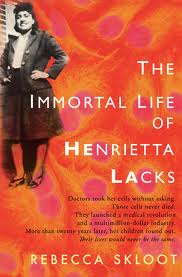
The Immortal Life of Henrietta Lacks

The Immortal Life of Henrietta Lacks was our book club selection for this month - it was also, coincidentally, the book selection of the year at the college where I work.  So there have been a lot of lectures and whatnot about the book in town recently (not that I like, went to any of them...)  I'd heard all this stuff about the book like how remarkable it is and so on, but I was quite disappointed.  The story of Henrietta Lacks eternally dividing cells and the impact they've had on scientific research is pretty remarkable, but the story that Rebecca Skloot has told is problematic, to say the least.

Henrietta Lacks was a woman who had cervical cancer and died in 1951.  Her cells, it was discovered, are "immortal" - they reproduce easily and have been widely utilized in scientific experiments around the world (they're called HeLa cells).  Lacks or her family was never notified that her cells were being used in this way.  She was an impoverished, uneducated, southern African-American woman and her family, even today, continues to suffer in poverty, ill-health and under-education today.  (As a side-note, it was interesting to read this book in conjunction with the national conversation about wealth and bootstraps - the Lacks family is a perfect example of how the poor stay poor.)

Skloot is very much a part of her own narrative - the journey to learning more about the life involved trying to talk to her family.  Henrietta's family, by 1999, had been burned many times by reporters and members of the medical community - Henrietta's surviving children and husband were never informed about their mother's place in scientific importance, and, being very poorly educated, they did not seem to understand exactly what had happened to her, before or after her death.  Skloot describes the process of talking with the family, particularly Henrietta's daughter, Deborah, an erratic women that vacillated between eagerness to talk about her mother and learn more, and sudden skittishness and privacy about her family matters.

What really comes across in this book is the extreme irony that the family of this woman who made such an important contribution (without her knowledge) toward medical science continues to live in poverty and, for example, has no health insurance.
"Hopkins say they gave them cells away," Lawrence yelled, "but they made millions!  It's not fiar! She's the most important person in the world and her family living in poverty. If our mother so important to science, why can't we get health insurance?"
However, what bothered me more and more was how this book was less about Henrietta's history and cells, and more about what a completely ignorant and superstitious family she had.  While so much of the book was devoted to how Henrietta, as a poor, black woman was considered fair game for medical experimentation without her knowledge or consent, I found it rather alarming how much of the family's bizarre, idiotic statements were included in what felt like the further advantage-taking of this family for someone else's gain.
"Daddy," Lawrence yelled, "did you know mam's cells gonna make Stevie Wonder see?" [...] Then there was a thump on the ceiling and the rustling of someone walking around, and Lawrence jumped from the table and ran into the kitchen. "My wife is a fire dragon without morning coffee," He said. "I better make some." It was two in the afternoon.
Skloot also describes the surviving family members' appearances, skin tone and texture with obsessive detail:
Deborah was a substantial woman - about five feet tall and two hundred pounds. her tight curls were less than an inch long and jet black, except for a thing streak of natural gray framing her face like a headband. She was fifty, but seemed both a decade older and younger at the same time. Her smooth light brown skin was dotted with big freckles and dimples, her eyes light and mischievous.  She wore capri pants and Keds sneakers and moved slowly, leaning most of her weight on an aluminum cane. 
Historically, the assumed character for white writers are white, while any non-white characters are the "other" and "require" description.  This started to drive me nuts after a while in this book because the players were either medical professionals or Lack's family.  The Lacks' skin tone, eye-brightness, and obesity was almost always immediately and indulgently described while those characteristics were not mentioned for the scientists unless they were not white.

I don't think that's uncommon, but just illustrates how unconsciously white writers (and readers) carry their own (even unknown or unrecognized) prejudices.  However deeply problematic I found The Immortal Life, it seems to have sparked a conversation for an ethical and legal issue that will most likely become more and more prevalent to our society.

Wednesday, May 02, 2012

Little Brother

I encourage everyone to read this great YA book by Cory Doctorow called Little Brother.  It's a about this kid (16 or 17) in San Francisco in the not-so-distant-future.  Marcus's world has a bit more surveillance than our world - in school, all students are issued computers that track their keystrokes and look for specified keywords.  The walls are lined with "gait recognition" cameras that try to match up gaits to people and track movement.  Everyone is tracked by arphids too.  Marcus is a hacker, and knows his civil rights really well too - when the principal calls him into his office to grill him about a recent campus hack, he plays it cool, asks the principal if he has an evidence and encourages him to call the police and his parents.

When Marcus and his friends are running around town playing a game, there is a terrorist attack on San Francisco and they are gathered up as suspicious characters.  (I'm not telling you anything that's not on the back of the book).  Marcus's cool responses don't work with the Department of Homeland Security - using post-9/11 legislation, they don't have to follow the same procedures as the principal.  Marcus is tortured, certainly never gets a call to his lawyer, or is ever charged with anything.  When he finally is released, he decides he'll do what he can to take the DHS down himself.

What's interesting is that, in a manner of speaking, Marcus becomes a terrorist after being released from the DHS, even though what he's doing is ostensibly for the good.  What I found endlessly fascinating is that (almost?) all the technology Doctorow mentions in the book is either existing today or not a far stretch.  I frequently found myself asking my guy, "Is TOR a real thing?"  It is.  "You ever heard of Thomas Bayes?" Yep.  "How does DNS work?" It's complicated.

Little Brother has a great story, but the didactic side is what I loved.  This book challenges the reader to consider how they feel about privacy and how far they would be willing to go to protect it.  It encourages readers to become more savvy - and it's really empowering:
If you've never programmed a computer, you should.  There's nothing like it in the whole world.  When you program a computer, it does exactly what you tell it to do. It's like designing a  machine - any machine, like a car, like a faucet, like a gas hinge for a door - using math and instructions. It's awesome in the truest sense: it can fill you with awe.
It's so fun to read a book about a city you know well - I used to live in SF, and a lot of the action takes place in my old neighborhood (affectionately known as the Tender-knob).  Marcus is a cool kid - he's a nerd, but this accessible book would appeal to both nerds and non-nerds (that term is also affectionate, by the way) - I would think this book would really inspire young people to start some interesting web searches - it definitely did for me!

Doctorow is a real revolutionary and an anti-DRM, liberal copywrite activist.  His wikipedia entry is a great place to learn more about him.  As a proponent of Creative Commons, Little Brother is available as a free download here.  Wow!  Why does he provide his books for free?  Read this.

Saturday, April 28, 2012

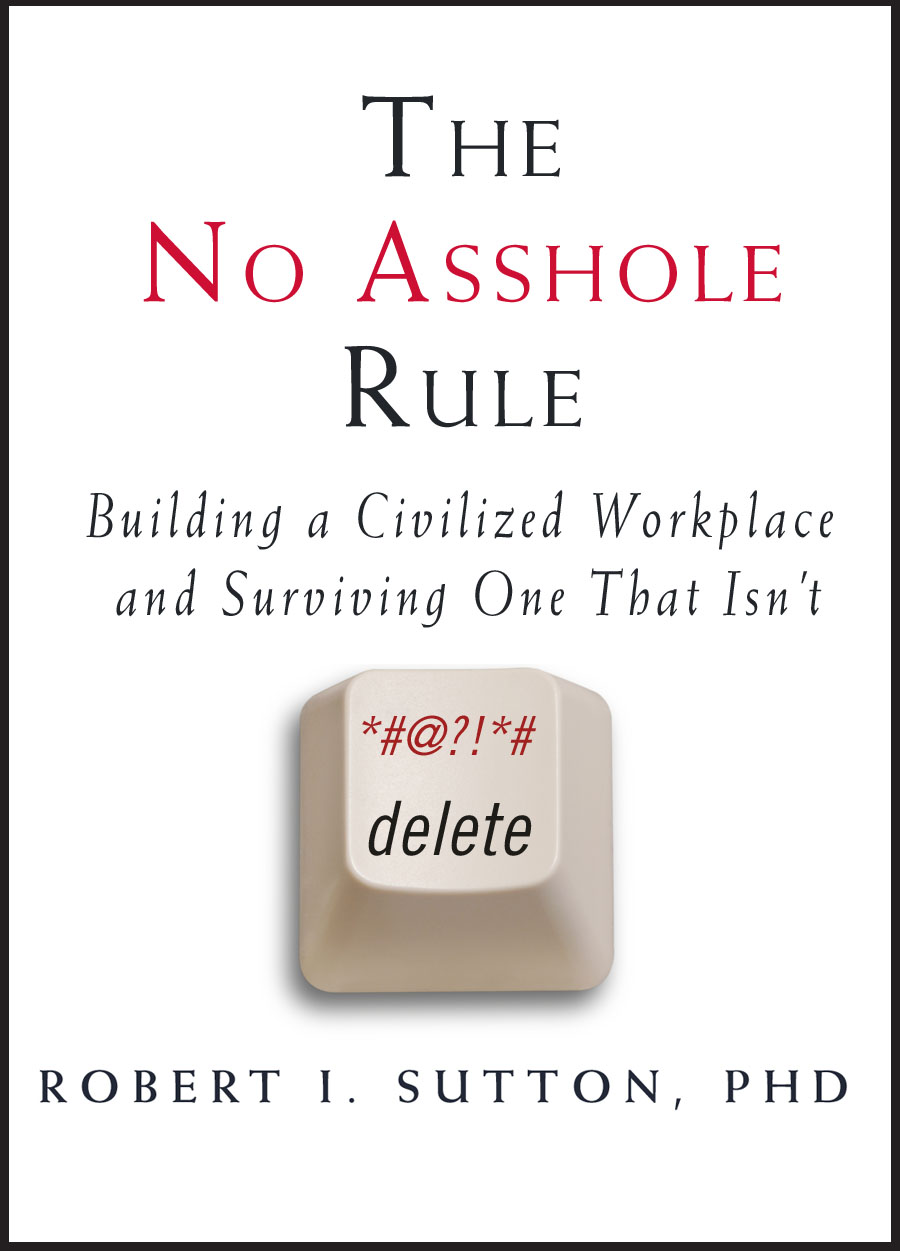
The No Asshole Rule

The No Asshole Rule: Building a Civilized Workplace and Surviving One That Isn't is a book based on author Robert Sutton's article in the Harvard Business Review - one of the anual "Breakthrough Ideas" of 2003 (the book was published in 2007).  


Sutton spends a lot of time setting up the premise - there are a lot of assholes out there, and they make workplaces miserable - from decreased moral, high use of sick time, decreased productivity to mental collapse.  It's bad.  Why're are there so many assholes?  I don't know.  His premise is simple: try not to hire assholes.  


His use of the word "asshole" is partly strategic, part cop-out.  He uses the term humorously, and, it IS fairly amusing to the see this mostly harmless curse word in every other sentence.  An asshole, by Sutton's definition, is someone who consistently acts like a jerk, "who belittles and demeans others in the workplace independently of gender, race or religious beliefs."  That's important - treating someone differently based on gender, race or religious beliefs (as well as sexual orientation) is illegal.  Being as asshole isn't.  So, when Sutton talks about managers removing "assholes" (by his definition), it's not entirely clear what he means.  As far as I know, you can't fire someone for being a jerk.  


As a hiring manager myself, I think I do a good job of finding people I want to work with (ie, NOT assholes), but, I must admit, I was more interested in this part of the title: Surviving One That Isn't.  I wasn't at all surprised to see that Sutton works in academia (also where I am).  I think most people would agree there are a disproportionate number of unpleasant folks in academia.  Just about daily I think about this old adage - Academic politics are so vicious precisely because the stakes are so small.  Sutton returns again and again to the "simple" solution if you're in an office populated by a-holes: just leave.  Well, sure, easy for him to say - but, that's pretty terrible advice in a bad economy (and not so great in a good one.)  His more "practical" advice is not much more helpful: Lower your expectations, "learn to feel and practice indifference and emotional detachment", "look for small wins" and "limit your exposure."  I frankly, do not want to to treat my work with indifference and emotional detachment - it's a part of my life - half of my waking day.  There's gotta be another answer, but it isn't in this book.*


I wouldn't really recommend this book to anyone, unless you enjoy reading shocking statistics and horrifying stories that may or may not be worse than your own.  He calls out a lot of people by name - some are well known, like Bobby Knight, other's less well - but I think all a matter of public record.  I'm thinking about passive-aggressively leaving the book laying around on my desk at work, but, if there's one thing I've learned, it's that Clueless People Are Clueless (it's true, there's a study and everything.)  One time at work this brochure went to everyone in the office that said to be aware if your behavior caused other people to, for example, back away, or avoid eye contact, or to cross their arms, etc, and I had a laugh with a friend about how many people it defined to a T, and then we got really sad because we realized it would take nothing less than a lightening bolt from the sky for someone to read that paper and say, "My God!  This is ME!  I need to change my evil ways immediately!"  


*Actually, there was one small bit of advice that I did like.  Sutton quotes a woman who uses advice from a white-water rafting instructor - if you fall out the boat, rely on your life vest - lay back with your feet in front of you and use your legs to bounce off the rocks.  In nasty meetings, the woman would literally stick her feet out under the table and imagine she was gently pushing off the offensive actions around the table. That's a nice visual I can work with!  

Monday, April 23, 2012

Monday, April 16, 2012

No fiction winner for Pulitzer this year!

Wow, the Pulitzer prizes were announced today and there was no fiction award!  Shocking, huh?  Swamplandia, by Karen Russell (I've really got to read that soon!), something I've never heard of called Train Dreams by Denis Johnson, and The Pale King (by Foster Wallace, which I have no intention of reading)  were short-listed.  I wonder what gives?  Apparently this hasn't happened since nineteen-seventy-something.