Tuesday, October 29, 2019

After the End by Clare Mackintosh

I asked Mike to pick up a copy of After the End on his last trip to London because it was getting a bunch of good press and I like my books to come from somewhere interesting if entirely possible.  In fact, I've finally started writing in the front of my books where I bought them so I can remember better.  And here's a free marketing tip from me to independent book stores out there:  why not make cool book plates of your bookstore and stick them in the inside cover?  Then it'd create like a cool badge of honor for people who go out their way not to buy from Amazon.

Anyway, I love bookplates (see my pinterest board on them!)

After the End is a desperately sad book.  Reading it made me very very sad and reminded me of a terrible time in my life and some of my worst fears coming true.  I asked myself many times, "Why am I reading this book?" before I skipped about 100 pages and finally read the last 20 or so.  It's about a loving couple who's child has brain cancer, and at the beginning is lying in a hospital bed, brain damaged, with a bit of cancer still in his brain, on a ventilator, unable to speak and barely move.  They disagree about the medical path they should take and go to court.  Then, this is about halfway through (SPOILER coming) the judge rules that the child shall receive no further care (beyond palliative, of course) and in another timeline, he rules the child shall receive additional care.  So, in one timeline, or reality, their son dies shortly after, and in another (alternating chapters), he lives an additional six years.  In both realities, the parents' marriage suffers greatly and their lives are forever altered by their devastating loss. Both parents and doctor question their decision. Following the two story lines allows the reader (and the author) to indulge in the fantasy of actually knowing the result of the other choice.  They are haunted by their choice, but at least in the book, the other choice's outcome is known.

You have to applaud Mackintosh for writing such an unflinching book.  She obviously set out to confront the horror of losing a child and that is precisely what she did.  In an "Author's Note", "This has been an incredibly difficult book to write, but one that has also brought me great joy" she writes. She also writes that she had to make a life and death decision for her son and I suspect that writing it was a cathartic experience for her. I'm glad she found joy in writing these parallel tales, but I honestly can't imagine many will find joy in reading it - although some people really love sad stories.  If so, this one is for you!

Saturday, October 05, 2019

New England Vacation Reading

When I go on vacation, I like to read fiction from or about the area.  For our trip from Boston to Acadia National Park in Maine, I read:

North of Boston by Elisabeth Elo.  This is a mystery about a woman who is out lobstering with her friend when they're hit by a larger ship.  Her friend dies, and she surely would have if she didn't have the uncanny ability to survive in ungodly cold temps.  Truthfully I found the book a bit convoluted with what felt like over-the-top details, like the main character's mother was a famous perfumer and her step dad was like a Ukranian mobster or something, and her best friend is a beautiful heiress and an alcoholic.  I mean, maybe I don't understand the northeast that well, but I was like, why was this girl out lobstering at night?  Anyway, Elo wrapped it all up with a bow and I had fun reading it, so, who cares?

Run, Ann Patchett.  Run takes place mostly around Cambridge, Mass.  It begins, as her books often do, with a killer first chapter that reads like a beautiful, stand-alone story (that nevertheless perfectly sets the stage for the novel).  One snowy evening, a father and his sons become entangled with a woman and her daughter.  A tender look at family, inheritance (tangible and intangible), race and class, this is Peak Patchett.  I love her.

Vacationland, by John Hodgman.  Did you know Maine license plates read "vacationland"?  That might seem funny to some jackass from Chicago (guess who? Me!) until you see how very beautiful it is there, and apparently in summer quite overrun with weekenders - in late September it was overrun with pensioners.  Hodgman is from Brookline, Mass, but writes at length about Maine and its curmudgeonly  and antisocial denizens.  Although most of the book is Hodgman cracking wise about making cairns while getting high and how he accidentally got famous and kind of rich making Apple commercials, he wrote this book while continually acknowledging his own white male privilege, just honestly and forwardly.  That was pretty damn refreshing to read.  He ends with a hard look at how in a place like Maine, composed mostly of wealthy white people, you can pretty much ignore the existence of racism and its terrible effect on minorities in this country.  I think about that sometimes too, like, I could quit reading news about black people being killed by police and I would probably be a lot happier. Anyway, a substantial chapter by a white male comedian on the importance of the Black Lives Matter movement and how white people need to commit themselves improving our society.  Then he immediately writes how he online trolled a dummy online after making a similar commitment and felt like an ass.  Because life is really complicated.  Unexpectedly woke and thoughtful.

Wednesday, October 02, 2019

Monday, August 12, 2019

The Silence of the Girls

Pat Barker tells the story of the Iliad mostly through the eyes of Briseis, who was a princess until the Greeks destroyed her city and gave her to Achilles as a slave.  Generally the story of Briseis and Achilles is portrayed as a love story, but Barker imagines the relationship quite differently, with Briseis feeling all the love a woman would feel for the person who had just killed her entire family and enslaved her, which is to say: not much.

Like Circe, Madeline Miller's wonderful novel about another minor female character in the Odyssey (and Galatea, and Livinia), the author tells the story from a feminist point of view, literally giving voice to a character who has just a handful of words in a book that is perhaps the first written account of toxic masculinity in western literature. 

Even though I knew what was going to happen, having seen Brad Pitt's ab-tactular rendition in Troy and, you know, other STUFF,  I could barely put The Silence of the Girls down.  What Barker does very well is move the focus to the women and help the reader imagine what it would be like to go from a life of freedom to one of enslavement.  "In later life, wherever I went, I always looked for the women of Troy who'd been scattered all over the Greek world. that skinny old woman with brown-spotted hands shuffling to answer her master's door, can that really be Queen Hecuba, who, as a young and beautiful girl, newly married, had led  the dancing in King Priam's hall? That that girl in the torn and shabby dress, hurrying to fetch water from the well, that that be one of Priam's daughters?"  The men fight in battles and either preserve their glory in conquest or perhaps in an honorable, brave death, but women suffer the consequences for the rest of their lives, a sorry footnote to the battle scenes.  But in these masterful retellings, the women not only become active participants in their own stories, but they also bear witness to the events.

The book reminded me of a performance of Trojan Women the IU theatre school did back in the 90s.  I was on the stage crew so I saw the show many times.  (What a season: Rough Crossing, Tom Stoppard, Trojan Women, Euripides, Hurleyburley, David Rabe, Uncle Vanya and Cabaret!) The actors created their own monologues that were interspersed throughout the show - it was all very 90's and felt like something special.  Anyway, I remember it fondly and also it wasn't too much work because all the sets were welded together and they didn't let the undergrads do that. 

image via
Silence of the Girls was shortlisted for the Women's Prize for Fiction if that impresses you (it does me!)  Happy reading!

Stay and Fight

My review of Stay and Fight, by Madeline ffitch, on Newcity!

Thursday, June 13, 2019

Commonwealth by Ann Patchett

What a absolute pleasure it was to read Commonwealth by Ann Patchett.  It felt like one of those books that was written just for me, and I was very, very sad when it was over.  I think I couldn't read that book for the rest of my life.  The first chapter, for one thing, is as exquisit as any writing you'll ever read.  It could stand alone as a perfect short story.  But then, (mini-spoiler) the tone dramatically changes and the second chapter is ANOTHER amazing piece of story telling. Then the third, then the fourth.  Those first four chapters, I'm not kidding, you, I was in AWE.

It sort of has a JD Salinger quality, in that the family in the story is similar to the Glasses - each person is so interesting and Patchett writes about them with so much love and affection.  Even the ones who are dicking around become beloved.  The excitement I felt when Franny was staying with her older, famous, author boyfriend in the Hamptons and their guests are being awful and she's just dumped the lobsters in the sea and boyfriend's horrible daughter is about to arrive - I was on pins and needles.

And Teresa! 
He is fifteen and ten and five. He is an instant. He is flying back to her. He is hers again. She feels the weight of him in her chest as he comes into her arms. He is her son, her beloved child, and she takes him back.  

And Holly!  And Jeannette's husband!  I loved those people deeply. Can't wait to read more by Patchett.

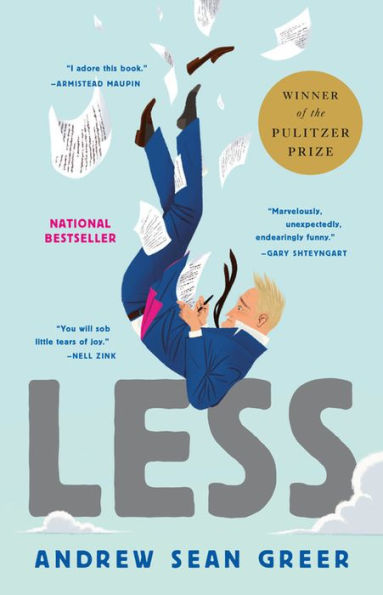
Less, by Andrew Sean Greer

Less was such an enjoyable read - I really loved every page, and I loved the way the story was structured with (Arthur) Less trying to outrun the marriage of his former boyfriend by traveling to all these different countries.  My favorite happened to be Germany, because Less suffers from a similar delusion as me - that he's very good at speaking a foreign language, although everyone responds to him with some amount of alarm of not understanding him.  There's even a line that perfectly encapsulates my own philosophy on speaking a foreign language.  "The key to speaking a new language,"she told them, "is to be bold instead of perfect."  That led to another bit that just slayed me:
He kisses--how do I explain it? Like someone in love. Like he has nothing to lose. Like someone who has just learned a foreign language and can only use the present tense and only the second person. Only now, only you. There are some men who have never been kissed like that. There are some men who discover, after Arthur Less, that they never will be again.
Swoon!

Another part that I thought about for a long time was this:
... As an areligious WASP, he had no idea what to do about death. Two thousand years of flaming Viking boats and Celtic rites and Irish wakes and Puritan worship and Unitarian hymns, and still he was left with nothing.
It is such an interesting fact how difficult it is to process a death. You'd think it would be more of our muscle memory after our long histories. 

Much to my surprise, I found myself reading a love story - I haven't really read one in such a long time, and it was an absolute delight.  Mini Spoiler - I loved how the third person narrator slowly revealed his own personality and became a mystery and then suddenly it became very obvious who he was. 

Thursday, May 30, 2019

The New Me

I ordered Halle Butler's The New Me before I even finished Jia Tolento's excellent review (Halle Butler’s “The New Me” Is an Office Novel for a Precarious Age) in the New Yorker.  Having just left my own toxic work environment.  A " late-capitalist nightmare"?  Sign me up!  Although, actually, don't.  Butler's novel is so bitingly caustic I had to put it aside for a few days, still feeling raw from my own experience.  So, read this when you're in a reasonably sane place, emotionally, because Millie, a millennial working "temp-to-perm" is not-so-slowly loosing her mind while trying to find permanent work, a loving companion ("really I would take anyone" she says), and, most wily of all: Happiness.

With only one horrible friend, a woman with "easily interpretable facial spasms", who clearly keeps Millie around to feel better about herself and a boring, low-paying temp job working for a woman eager to be the most dominant person in the room, there are no female heroes in this story (no male ones either).  The creeping ills of capitalism infest Millie's world.  "In the copy room, she bends down and brings out a small document shredder and pushes it toward me with her foot. She looks at me like I know what this means, like she's shown me the lord's chamber pot and I'm supposed to understand."

Butler's book definitely skewers capitalism, but I was left wondering whether or not this book is a satire.  (My working theory is that Americans have a hard time recognizing satire or maybe just me and like literally everyone I know?)  Eager to find out, I read a couple of interviews with Butler - while insightful, they did not answer my question, although, I'm not sure it matters that much.  Millie's experience is occasionally dreamlike and she frequently veers toward the Untrustworthy Narrator but what she experiences as a character is what many American workers go through on a daily basis: the indignities of low paying jobs and the soul-crushing experience of trying to make a life when you're exhausted at the end of the working day.

The New Me is not only a great addition to the annals of literature about "work" but also really captures the experience of some/many women struggling to find their way in life.  

Thursday, May 09, 2019

Milkman by Anna Burns

We were lucky enough to go to London a couple of months ago and one of the top items on my shopping list, aside from some sweet Harry Potter swag was a paperback copy of Milkman by Anna Burns - winner of the Man Booker (2018) and shortlisted for the Orange Prize (aka Women's Prize for Fiction) and a whole bunch of other awards.


The first chapter is (sh)amazing.  Nay, the first sentence is amazing, and almost (spoiler alert) spoils the whole book. "The day Somebody McSomebody put a gun to my breast and called me a cat and threatened to shoot me was the same day the milkman died."  The main character, who is never named


goes on to explain that this guy called the milkman was trying to insinuate himself in her life. "I didn't know whose milkman he was. He wasn't our milkman. I don't think he was anybody's. He didn't take milk orders. There was no milk about him. He didn't ever deliver milk. Also, he didn't drive a milk lorry." (That's page two.)


I'm spelling this out because this is one of those new fangled, old-fashioned books that isn't very plot driven.  Basically, that's the plot: the milkman tries to ingratiate himself, he's eventually shot and Somebody McSomebody sticks a gun in her breast.  And yet, it is 350 pages of beautiful English language about life in Northern Ireland during "The Troubles".  Occasionally it veers into the territory of how when women band together, they can accomplish amazing things (like momentarily put an end to street violence that overtakes a town or help a girl out in the 'Ladies)


and occasionally how women do awful things to each other, by creating and prolonging misery just to have a moment of power in their otherwise powerless lives.  Or they're so beat down by a paternalistic, patronizing community that they themselves maintain the very power structures that are detrimental to their lives and happiness.


Milkman was difficult to read, I ain't gunna lie. The chapters are like 50 pages long, there's a new paragraph only about every three pages, it was about a time that I don't know that much about, and, did I mention no one in the book is called by their name?  There's Maybe-boyfriend, the Milkman, of course, then the actual Milkman (who delivers milk), first sister, second sister, First-Brother-in-Law through Third, and the Wee Sisters, who are actually three very charming younger sisters, and many, many others.  Actually, the names are not a problem, I loved that aspect, and Burns is brilliant about how she helps the reader maintain the thread with this large family.  Despite the challenges, it was a really rewarding book to read, and my copy is now full of underlined, insightful phrases, things to look up, definitions of words I didn't know.

There are a lot of themes that run through this book but one of the major ones is that people who live in war zones are traumatized.  It sounds simple, but, unfortunately, think of what a huge population of this earth lives in violent communities.  Not only is it hard/impossible to invest in society/arts/humanity as a whole, but the trauma to the individual is a heavy burden that's nearly impossible to overcome.  Maybe-boyfriend says, "It's that you don't seem alive anymore. I look at your face and it's as if your sense organs are disappearing or as if they've already disappeared so that no one gets to connect with you."  Or, as Jonathan Van Ness might say it:


SO!  Where does all this leave us?  A challenging book, not plot driven, let's face it: a very depressing look at a violent place in time that destroyed so many lives (did I mention parts are quite funny?)  I really think this book probably isn't going to be everyone's cup of tea, but it was a journey I'm glad I took.


Thursday, May 02, 2019

Eternal Life by Dara Horn

Dara Horn's latest is yet another amazing novel that once again has come out a bit under the radar, much to my surprise.  She's too good to be under the radar!  Eternal Life bears a significant comparison with Kate Atkinson's Life After Life, in which the main character comes to life again after every death she experiences.  Unlike the Atkinson character, however, Rachel was born 2000 years ago in Jerusalem.  Horn's descriptions of 1st century Jerusalem and the life of her young Jewish heroine are rich and exciting, combining what's got to be a ridiculous amount of research and a fertile imagination. 

In the present time, Rachel deals with contemporary issues like figuring out how to die and be reborn when a digital signature might follow her.  This becomes especially difficult after her granddaughter takes a sample of her DNA without permission.  But some patterns are all too familiar.  A group of ill-informed protestors gather outside her business in New Jersey, an innocuous event to most of her family but a frightful reminder for Rachel. "She could hardly think of a time when it hadn't started this way, with people yelling outside her store."  Rachel has seen it all - the only thing that really surprises her is when a male lover helps out with the housework. 

Like her previous novel, The Guide for the Perplexed, Horn impeccably mixes the seemingly incongruous worlds of slightly futuristic (though plausible) technology with ancient Judaism and makes it look easy. Of course, the hyper-computing of today, with its general goal of collecting data, is not too dissimilar to the goals of Rachel's scribe father, capturing the written word of religious figures of the day.

I love the intellectual challenge Horn's books offer - this book is funny, and sad, and smart.  It's a real treat for the imagination, and as I also do when I read her work, I learned a lot. 

The Optimist's Daughter

Faulkner House.  Image via
When I was in New Orleans last month, I took myself to a couple of bookstores in the French Quarter.  I love visiting bookstores on vacation, they really seem to stick in my mind.  One was Arcadian books, a frickin' tangle of books that felt like an avalanche was going to fall on me at any moment (which is not to say that I didn't love it) and the other was Faulkner House Books, in the same house where William Faulkner lived (both bookstores are near the cathedral). It is small and extremely civilized, it has the size of a fabulous private library, and for a few precious moments I had it to myself until a small crowd of maybe four people came in, making it almost unbearable.  However, I did overhear an amazing exchange between customer and proprietor that went something like this:

"I'm trying to remember the name of an author..."
"Hum me a few bars," she said. How charming is that?
"Well, he's a young man..."
"Black or white?"
"Black..."
and she gestured at a book on the shelf behind her...
"That's him!" 
Amazing.

I picked up a Eudora Welty, looking for something southern and New Orleans-related - The Optimist's Daughter, something I'd never heard of, but was pleasantly surprised to see had won the Pulitzer.  It's a quiet, short (180 pages) book about a woman, Lauren who has returned to her home just outside New Orleans while her dad has surgery. She's been living in Chicago after attending the Art Institute (hey, just like me!).  Her dad has married a young woman, maybe the same age or younger than Lauren, who's not as sophisticated or respected as Lauren's deceased mother. Her dad dies unexpectedly, and Lauren goes through the funeral and goes home, The End.  I could really relate to the hospital and funeral scenes, in which people say and do stupid things, but Lauren just suffers through.  Actually, Welty gives few details about Lauren's interiority and I was really struck by how little access I had to the main character's interior voice and thoughts. Lately I've mostly been reading contemporary literature and it was a real change to experience something written 40 years ago.  I've read most of the Pulitzer Prize winning fiction books since the 90s and I was really quite surprised that this ostensibly simple narrative tale won in 1973.  It's amazing how literature tastes have changed in the last half century.  But, actually, it wasn't a simple story, after some reflection. As Lauren floats through encounters with her hometown community, they prattle on around her and she says very little. What made it fun as a reader was to imagine how Lauren might have felt about the absurd things people were saying because she was too polite or tired to respond.  It's with a deft and delicate hand that Welty wrote this little novel, a real pleasure to read. 


Wednesday, April 10, 2019

Dystopian Novels: Women's Edition

There have been some absolutely amazing novels published recently reflecting the fear of the current political and social climate continuing and the potential disastrous effect it could (continue to) have on the lives of women. Louise Erdrich's Future Home of the Living God (2018) is my favorite - it begins with a road trip by an adopted daughter to visit her birth mother, an Ojibwe woman who lives on a nearby reservation.  Cedar's adoptive mother and father are anxious as she leaves because there is a "a new kind of virus. Maybe bacteria. From the permafrost. Use hand sanitizer."  Cedar is pregnant, and ostensibly visits her birth mother to ask about inheritable diseases.  What Erdrich teases out in those first few pages about a possible virus eventually becomes an excuse to police women's bodies. Within the larger global drama she's created exists a beautiful story about the love this family has for each other.  And within that narrative is the protective instinct Cedar has for her developing child, with not-so-subtle allusions to a newborn Christ. Which had me thinking, isn't it a natural reaction to consider that the child you bear might be the savior of the world? Listen, I get very *eyeroll* over pregnancy stories, but Future Home of the Living God had me ALL IN.  I've only read two of Erdrich's books but she's quickly becoming My Favorite Author Of All Time.  

Last year I saw Margaret Atwood speak and she hyped The Water Cure by Sophie Mackintosh (and also, coincidentally, hinted at a big announcement to come which ended up being The Handmaid's Tale: Part Deux, which I now realize was painfully obvious). I wanted that book so bad I ordered a British copy.  Three girls live with their mother and father on an island and women visit to experience the water cure, administered by their parents.  The girls are under the impression that the outside world is a lawless, dangerous place for women and therefore they've created this extreme but safe oasis for them. The parent's solution, and how it further breeds mistrust between women, was a striking example of how isolation isn't the answer to the world's problems. (Hello, Mike Pence.) 

Christina Dalcher's Vox is perhaps the most infuriating (in a good way?) of the recent batch of dystopian novels.  In it, all women, even young girls, are required to wear a bracelet that provides an increasingly painful electric shock every time they speak over 100 words in 24 hours.  What really struck me was how the main character's daughter never came near her 100 words and easily adapted to this new paradigm, simply by the socialization of those around her.  It made me bristle to remember every time that I had been told that I talk too much, that I was better seen and not heard, that I was too loud, to forceful, and every argument I've ever heard that women aren't suited for certain positions and roles due to nature or religious conventions.  (Reminder:  It is commonly perceived that women speak much more than men - we don't.) . So, if you like being filled with RIGHTEOUS and FURIOUS ANGER, you should definitely read Vox (seriously, you really should.)

Cross Her Heart

Sarah Pinborough’s Cross Her Heart is so full of twists and turns it got me thinking about the modern novel, post-Gone Girl, and the role of the Unexpected Twist. First, it dawned on me that the “twist” actually existed BEFORE Gone Girl, it just wasn’t called a “twist.”  I mean, wouldn’t a nineteenth century reader be absolutely shocked to discover that, just as Jane was about to marry Mr. Rochester, she finds out his WIFE is living in the attic of the damn house she’s been living in.  THEN, when she hears his voice one night, goes back to Thornfield mansion to find the damn place burned down, Rochester’s wife lept off the fucking ROOF and he’s blind and only has one functional hand.  That’s ALMOST as nuts as Amy framing her boring husband for her own murder, then double-framing her ex-boyfriend instead, and then getting herself pregnant with some sperm she hid in the freezer JUST IN CASE this whole scheme went to shit.

Secondly, I am getting tired of books with crazy twists, although I almost always have to doff my hat to those that do it well, as Pinborough does.  I like reading mysteries, and it often it feels like mysteries are written in a formulaic way, with twists, with “girl” in the title, and ladies being raped and murdered on the page for reading pleasure (concerning all these conceits - see this whole crazy story re: AJ Finn and The Woman in the Window).

Anyway, to summarize Cross Her Heart would be too difficult without giving much away, aside from saying that it’s a captivating read, and I had a good time apprising M for a few days at the multiple twists and turns it made (namely re: some missing girls on vacation in Thailand and a concerned journalist.)  

Saturday, January 26, 2019

The Dreamers

Karen Thompson Walker creates stories where an impossible event takes place, yet she paces it out so slowly and thoughtfully, it seems like the most natural thing in the world. In The Age of Miracles, the rotation of the sun slows until a single day lasts weeks; in The Dreamers, the population of a town is affected by a virus that causes people to fall into a deep sleep. At first a student in a dorm falls asleep, then, quickly others. The dorm is placed under quarantine, and then the town is placed under cordon sanitaire, a French term I was happy to learn, dating from medieval times and referring to a physical or guarded barrier that separates an infected area. 

The doctors and scientists who study the sleeping townspeople and college students soon discover that they are dreaming: 
The true contents of the dreams go unrecorded, of course, but in some patients, the accompanying brain waves are captured with electrodes and projected on screens, like silhouettes of the hereafter. [...] There is more activity in these minds than has ever been recorded in any human brain - awake or asleep.
Walker's narrative voice in The Dreamers feels like an all-seeing eye that peels back the ceiling of first this house and then another, revealing the contents like a dollhouse, or a scene in a Wes Anderson movie.  For example, some patients are kept in the college library, for lack of space. 
  In the Classics section, a visitor could read about the oracles of ancient Greece and Rome , how the people of those eras believed that dreams could sometimes reveal the future.
  One floor down, in the Psychology section, one might eventually discover that Carl Jung, at a certain point in his life, became convinced that he had dreamed of his wife many years before he met her.
  On another part of that same floor, in Philosophy, one could entertain the theory that if you could truly understand the complexity of reality, you could accurately predict the future, since every moment of the future is set in motion by the events of the past - the whole system simply too complex for the human mind to model.
She taps into the sense of environmental unease that permeates our society, and, in this case, literal isolation of people who are living in what feels like a complex and dangerous time, always on the brink of natural or man-made disaster.  The Dreamers shares themes with another book I've read recently, Nick Drnaso's graphic novel, Sabrina.  In each, internet fear-mongering runs rampant, with ignorant trolls both blaming and diverting.  Conspiracy theories run rampant, claiming that what we, the reader, know to be true, never actually happened.

How people react to disaster is a common theme in Walker's books. Two sisters find fortitude in each other while their dad sleeps; a young man from the college imagines himself a savior while he endangers those closest to him.  Most people close ranks, concentrating only on themselves or their families.  The virus further isolates people who are already isolated. 

Ultimately, this book caused me to think about dreaming and consciousness in a different way.  I love any book that sends me on a search - to learn more about a word or an event.  Walker's clear love of language and desire to understand human reactions to extreme situations permeates The Dreamers with an infectious (why am I the way that I am?) curiosity.


Tuesday, September 18, 2018

Lake Success

One consolation of Fascist regimes is great art, and I'm not hesitant to call Gary Shtyngart's Lake Success one of the great novels to emerge in these dark times.  Taking place mostly in the months before the 2016 election, the characters and motifs reflect the attitudes and atmosphere in America that led us to elect a swindling, racist, misogynist who can't even read the word "anonymous" off a teleprompter.

Shtyngart's anti-hero is Barry, the owner of a hedge fund, lover of watches, with "two feminine wrists, a liability at any point in history, but never more so than during the year 2016, at the start of the First Summer of Trump."  Barry's life in contemporary Manhattan, ruled by finance bros like himself in fleece vests, earning 2% of assets under management (AUM) whether they make money or lose it for their clients, is ideal, with the exception of his son, an child with autism who has never spoken and Barry is truly struggling to love.  One night, after his wife tells him he's neither a good father nor a good man, he hugs the child too vigorously, frightening him and terrifying his wife - he flees the apartment with a roller-bag and six of his favorite watches and jumps on a Greyhound, running away from his problems in New York, ostensibly toward an old college girlfriend in the American South.

That Shtyngart's describes both the Greyhound and the designer watches in such loving tones and hilarious detail speaks to his fondness for both institutions, however separate on the financial spectrum.  Barry yearns to prove his wife wrong, but he's so out of touch with the world outside his own that he fantasizes about starting a foundation with a young crack dealer he meets in Baltimore, "One that would help urban youth buy their first mechanical watch and learn to care for it." Shtyngart's descriptions of both watches and the Greyhound were, in fact, so precise that I began to wonder how much research he must have done to achieve the high level of specificity found in the book.  At first I thought he was pulling the descriptions of these watches from his imagination, but I googled a few and they were all real, much to my surprise (ie. a $60K "Crash" watch by Cartier, designed to look like it had survived a disaster).  It turns out Shteyngart is a long-time watch enthusiast - but what about the Greyhound? Turns out he took a similar journey to Barry's in the months before the election. In June, the New Yorker published a portion of the novel called "The Luck of Kokura" along with an interview with Shteyngart that sheds some light on this. (There's also an enlightening article and some beautiful pics of his second house north of NYC in the Times.)

Like many people, I want to find a comparison between the author's personal life and the characters in their novels. So I couldn't help but perk my ears when I read that GS is married to a Korean-American lawyer and they have a small child, similar to another character in the book.  I've written about autofiction before, and how women have long been accused of blending their personal lives into their art.  I find it interesting that, as more men are writing in this style (ie Karl Ove KnausgÃ¥rd, who I refuse to read for purely obstinate reasons) it's gaining some literary cachet.

Mini-Spoilers Ahead

While Barry's trip "on the 'Hound" brings him into physical proximity with people in lower economic status than himself (he loves bragging that a one-eyed Mexican fell asleep on his shoulder), he remains emotionally aloof to the lifestyles and struggles of Middle-America for most of his journey.  Only when forcing his way into the home of his ex-girlfriend and her son does he begin to relate to the life of the "common" American, and finally, the reader is able to somewhat relate to Barry.  It becomes apparent that Barry himself is "on the spectrum" (the words more commonly used to describe his own son).  Barry's ex works at a community college in Texas where the working-class students are making real sacrifices to educate themselves, while she and Barry had the privilege of attending Princeton where their path and trajectory to success were practically etched in stone. She and her colleagues are also making sacrifices - money, any fame, even death-threats from #MAGA assholes on Twitter.

However Barry might slightly redeem himself, I had to wonder as I got nearer the end of the book how in the world Shteyngart could wrap it up?  What resolution or restitution could Barry possibly perform to find his way into the graces of his wife and son and the reading audience?  Without giving away the ending, which reminded me quite a lot of the end of Jennifer Egan's Visit from the Goon Squad, he finds a remarkable way of not only humanizing Barry but creating in him a (somewhat) sympathetic character.   I found the ending deeply, deeply moving.
"Things could be fixed.Barry could fix them."


Monday, January 08, 2018

The Pearl Thief


You know that phenomenon when you learn about something new and then suddenly it's all around you and you can't escape it? Last year I fell down this weird rabbit hole of "bogs" and stuff that gets preserved in them - first in the form of 2000 year-old-butter that was found in an Irish Bog ("What even is a bog?" is a question I asked myself back in those antediluvian days). That story was naturally a frequent topic of conversation with our foodie friends, all of whom were, of course, well-read in the subject of world-butter-revelations. Then I watched some British mystery about a body found in a bog, slightly clearing up the question of what a bog is with helpful visuals. Then I fell deeper in the rabbit hole when I happened upon a fascinating long-read in the Smithsonian about Tollund Man, which is about you guessed it: ancient human sacrifices perfectly preserved in European bogs!

THEN, seemingly unrelated to all of that, I read The Pearl Thief, which I was so invested in I ordered it straight from Across The Pond, having previously been obsessed with Elizabeth Wein's Code Name Verity, although not so much Rose Under Fire, its sequel.  (For those of you keeping score, you'll notice all this news and the British publication all happened around June '17 and that is just how very, very far behind I am in my book bloggin'.)  In it, Julie Beaufort-Stuart returns to her grandfather's castle-estate in Scotland for one last summer before it is sold.  Julie immediately befriends some local Travellers who are long-time visitors to her family's land and thus is introduced some sympathetic and didactic history of Travellers in the area and the discrimination and abuse they often suffered. There are several mysteries that must be solved not least among them a BODY FOUND IN A BOG!  (Spoiler!) Which of course I immediately knew was an ancient triple-death sacrifice.

Julie is a beloved character from Code Name Verify and it is wonderful to get to spend more time with her. The Pearl Thief precedes that story in the narrative so the reader sees the open-hearted, privileged young woman before the war.  Hints of Julie's fluid sexuality are confirmed and her feisty, honest nature is further solidified.

Although The Pearl Thief occasionally reads as if it's truly written for a younger audience, being mildly over-didactic and specifically inclusive in a way that YA books sometimes are, over-all the book was very charming and had interesting things to say about living with history and how history, naturally, informs the present.  Also, Julie has Schiaparelli blouse that I spent a lot of time imagining.

Saturday, October 14, 2017

Elmet

Elmet was the dark horse of the Man Booker short list and after reading an intriguing review I found a copy at my library. Side note:  History of Wolves and Exit West were also nominated and I looooved both of those - although so was Lincoln in the Bardo and I swear to God I cannot get through that thing.  Although everyone else is going absolutely nuts over it so who am I to judge? 

"Elmet", it should be known, was the name of the wild country of northern England back in the 5th century and also the subject of an epic poem by Ted Hughes. (Favor a challenge? Read the Wikipedia page on Elmet. Sample sentence: "In the Tribal Hidage the extent of Elmet is described as 600 hides of land, an area slightly more than the total of the wapentakes of Barkston Ash and Skyrack." Whaaaaaaaaaaaa?)

Fiona Mozley is a young, British author and this is her first book. She writes lovingly of a small, odd family composed of "Daddy", Daniel, the narrator, and Cathy, his sister.  They're sort of like squatters and build a house on someone else's land and mostly live off the land, eating wild animals and trading with people in the nearby village.  Daddy occasionally engages in a fist fight for money.  Most of the book is allotted to the almost devotional descriptions of the home and the food eaten in the home.  The family's house build completely by them, covered in moss, evokes a feeling of deep contentment, even despite Daddy's occasional dark periods when Daniel and Cathy retreat to the outdoors to give him some space to expel his demons.  Interspersed throughout the book are very short passages that indicate Daniel is chasing a woman - one can only assume it is his sister - and it is unclear why or how this came about.  As Daniel runs, his narration becomes even more poetic - he is almost animalistic in his single-minded pursuit:
I see bovine silhouettes shift steadily across meadows, hulking their uneasy weight from trough to furrow, and elsewhere, I see the dusk settle on the fleeces of grazing ewes like sparks from flint to tinder. I watch the land glow and the sky burn. And I step through it with a judicious tread.
I pass from Elmet bereft.
Jesus Christ!  Right????  Although, to be honest, I personally do not like the otherwise over-all style of this book which is heavily stylized prose composed of short, Hemingway-esque sentences in the past tense.  It reminded me of Kazuo Isiguro's Never Let Me Go which I really, really hated.  But, he just won the goddamn Nobel Prize for literature, so what do I know? But, I mean, look at this:
We arrived home and Daddy went straight out into the woods with his tools. The shell of our house was sealed tight against the winter but the insides remained rough. Daddy was working on the lining and on the floors. Wood was the material he used as much as he could. It was right there in the copse. Trees of different ages and different kinds.
I mean, honestly.  However, unlike Isiguro's much lauded novel which goes absolutely nowhere, Mozley's book is building to this completely bonkers ending that I am still mildly in shock about several days later.  Also, it cannot be forgotten that what's she's doing is building upon a great literary tradition and drawing connections between people who occupied her country in the 5th century to the way we live today, bringing up important questions like what it means to inhabit a land... what is "home"... the role of collective history and memory, and what is it that composes our very society?

It's pretty much worth reading just for that insane ending, if you enjoy being tortured by literature and then literally shocked out of your senses and... who doesn't, amiright?

Saturday, October 07, 2017

Under the Harrow

Under the Harrow is Fylnn Berry's first novel and a winner of an Edgar Award this year.  It takes
place in England but Berry is an American.  You know I love my British Lady Mystery writers!

Early spoiler and possible trigger warning:  a dog dies.

Nora arrives at her sister's house to find her sister (and her dog) murdered.  She reels.  Actually, a good part of the book is Nora recovering from the shock of discovering the gruesome murder and the loss of her sister.  Nora isn't aware of anyone who would want to harm Rachel - however, her sister was the victim of an attack when she was younger by a stranger.  The police tell Nora that it's statistically unlikely that a woman would be the victim of two attacks by strangers in her lifetime - they look, of course, to old boyfriends and, eventually, to Nora herself.

As a narrator, Nora is a bit unreliable - she forgets things and, though the reader seems privy to her most solitary moments, something like the hotel manager coming to say the other guests are complaining that the noises (presumably her screaming and crying) are disturbing.

Unsurprisingly, Under the Harrow confronts misogyny and violence toward women.  Accusations are levied against Rachel for her behavior, the hour, her clothing in her first attack, and after her death Nora is cautioned to avoid talking to the press lest they expose "the worst parts of her" to the world. The team that was this sisterhood is not the sentimental fluff you might expect from a "sister novel" but a complex, deep relationship. It is fierce and devoted.

Here's a particular passage I related to - on losing her Yorkshire accent during college: I changed my voice the way I would have chewed off my leg to get out of a trap. Every time I heard my cool, even accent, I thought - I've left. I'm gone.

As mystery's go... it's one of those that's virtually impossible to solve yourself, but it's more about the journey that Nora takes to find justice for her sister.  Berry's a really fantastic writer and I love the way she puts her sentences together.  She crafted a great story here that had me skipping back pages to re-read the careful unravelling.  Really quite an amazing first book!

By the way, "under the harrow" is from a CS Lewis book, A Grief Observed.  Even if you don't know what it means, it's evocative.  Berry explains more in this interview.

Sunday, October 01, 2017

Sing, Unburied, Sing

Jesmyn Ward's Sing, Unburied, Sing is a painful but rewarding novel about a young boy, Jojo, and his family in Mississippi.  Jojo and his baby sister are being raised by his grandparents because his mother is a meth addict and his father is in jail for cooking meth.  His grandparents are loving, gentle people, but his grandmother is dying of cancer and things are falling apart.  Jojo's mother, Leonie, comes in and out of their lives - when she needs something. Her children are, at best, inconsequential to her, and at worst, active sources of resentment.

Leonie's parents practice what I believe is Santaria - her mother is very knowledgeable about herbs and was a midwife and both she and her husband make "gris-gris" bags - small pouches to protect against evil spirits.  The grandmother hears spirits and prays to some kind of sacred feminine.  Ward's goal is not to educate the reader on this religion - it's just part of the rich history of this couple, which makes it all the more agonizing that they have this gifted daughter who turns out to be a terrible mother and makes horrible choices.

Leonie drags her children a long journey to  retrieve her boyfriend from Parchman Prison - a place where her father and uncle also were incarcerated in the early 20th century.  I was horrified to find out this is a real place and is in fact, still an operating prison.  In case you're not aware of this place, for many years it operated as an extension of slavery well after slavery was outlawed in the United States, and black men and women were arrested for minor crimes and then forced to work long days under inhuman conditions.  Anyway, all kinds of crazy shit goes down during this trip, with Leonie desperately trying to use her kids as props in what she imagines will be the joyous reuniting with her boyfriend while entirely ignoring their physical and emotional needs.

What I haven't mentioned is that Leonie and her son also have the gift of sight - what we are to understand from the Grandmother as the ne plus ultra gift, the one that she herself does not have.  Leonie sees her brother, Given, who was killed by white men in his community, and Jojo sees his uncle Richie, who died in unknown circumstances in Parchman.  Both are overwhelmed by these visions and unsure how to deal with them, and neither mention these occurrences to anyone.  What these spirits, or unburied souls, come to exemplify is the literal embodiment of the destroyed black body in our terrible shared history.  Unable to escape this history, which for Leonie and Jojo lurks and the peripheral of their nearly every moment, they remain plagued by the history of violence and heartbreak that wracked their community.

Sing, Unburied, Sing (that title!) has rightly been nominated for the National Book Award and I think will continue to do very well. Ward's lyricism and tight control of these many and various complex themes is so impressive.  I hope you'll give this powerful book your attention.