Monday, January 29, 2024

Shadow Tag


I haven't read a single thing by Louise Erdrich that I haven't loved.  All of her books are so inviting and absorbing, even if they're deeply sad and heartbreaking.  
Shadow Tag is terribly sad - about a couple who can't get away from each other.  They bring out the best and worst in each other.  She is his muse, literally and figuratively - he's an artist who has painted her throughout his career.  His paintings range from objectifyingly perfect to humiliating images they don't want their children to see.  I really love fiction about art - and in this book, with the slightest details, you're able to imagine a body of work from this man and woman.  It reminded me of a few other novels that have grappled with real and fictional art like Zadie Smith's On Beauty or Dara Horn's In the Image.  Interestingly enough, both Smith and Erdrich refer to Rembrandt's paintings of his partner, Hendrickje Stoffels, with great affection and generosity toward the sitter.


The wife, Irene, is has an unfinished PhD thesis on the (real life) American Artist, George Catlin, who painting Native Americans in the early 19th Century.  One painting in particular that Erdrich refers to in Shadow Tag is "Mi-néek-ee-súnk-te-ka, Mink, a Beautiful Girl" or, "The Mink".  Irene teases an imaginary history (as far as I know) around the creation of this painting and its meaning to Mink's tribe (the Mandan), and then revisits and  corrects it, exemplifying the way native people's history is sometimes fictionalized for the sake of mere entertainment, obfuscating or hiding the real story for various reasons (well, generally to make white people look better). It frustrates Gil, the husband, that George Catlin, a white man, was able to make a lucrative career painting Native American people, while he, as a Native American himself, would limit his career with such a subject. 
Don't paint Indians. The subject wins. A Native painter himself had said this. You'll never be an artist. You'll be an American Indian artist. There will be a cap on your career. You'll only go so far. You'll set up expectations. Attract only one set of collectors. Look at Rauschenberg. He was Cherokee. Did he paint Indians? No.

These, of course, are Gil's thoughts, or perhaps intrusive stereotypes that have been impressed upon him in his life as a (successful) artist.  Erdrich goes on to write of Gil:

His technical mastery had pushed his paintings past the west and Southwest, into Los Angeles and Chicago, Phildelphia, Washington, and then at last into New York, but he had not made the big leap. He was still classified as an American Indian artist, or a tribal artist, or a Cree artist or a mixed-blood artist or a Metis or Chippewa artist or sometimes and artist of the American West, even though he lived in Minneapolis. 

Gil is actually "unrecognized" by any tribe, although his heritage is partly Native American.  By the way, isn't it amazing how Erdrich brings so much humor to this situation, despite these painful, repeated attacks on his ancestry/identity?  And speaking of Minneapolis, Gil often drives to the museum in the morning to sit in front of Rembrandt's Lucretia.  [Side Note: 1. Sitting with art for extended periods of time is a wonderful privilege and if you have access to a museum or location where you can visit great art the breadth of understanding you'll gain from the work and the impact it can have on your life is invaluable. 2. This painting of Lucretia involves the incredible portrayal of a person who is quickly expiring!  See also Judith Beheading Holofernes by Artemisia Gentileschi and a Caravaggio painting of the same subject, for example.] Without putting too much of a giant bullseye on it, after having finished the book, Gil's fascination of an image of a woman who sacrifices herself for her husband is not surprising.  

The book is actually not that much about these images, but Erdrich obviously has a really strong background or understanding of art and art history/theory to make it one of the many themes that resound in Shadow Tag.  I find it so exciting when my loves/interests collide so it certainly stood out for me.  


Sunday, November 21, 2021

Beowulf and The Mere Wife

Maria Dahvana Headley wrote a book called The Mere Wife in 2018, and then a rather famous translation of Beowulf in 2020.  The translation from Old English made a big splash when it came out last year for being a “feminist” version and one of the few translations by a woman.  Headley’s translation is gloriously readable, as she has updated the language - famously translating the tricky first word “Hwæt”  - often translated as “listen”, “ho”, “behold” and so on to “Bro”.  Makes perfect sense - how else do men get each other’s attention these days?  Check this out:


Old English, anonymous, 8th or 11th c.

Hwæt. We Gardena in geardagum,

þeodcyninga, þrym gefrunon,

hu ða æþelingas ellen fremedon.


Seamus Heaney, 1999:

So. The Spear-Danes in days gone by And the kings who ruled them had courage and greatness. We have heard of those princes’ heroic campaigns.


Maria Dahvana Headley, 2020

Bro! Tell me we still know how to

talk about kings! In the old days,

everyone knew what men were:

brave, bold, glory-bound.


If you haven’t read Beowulf recently, it’s 3182 lines of Old English alliterative poetry (meaning the first sounds often start with the same letter).  The first manuscript was created between 975 and 1025 but the story takes place in 6th century Scandanavia.  The story is pretty simple:  This king’s castle is being raided every night by Grendel who kills and eats some people and fucks off before anyone can even injure him.  So Beowulf, a nearby dude, takes a boat over to this castle, tells everyone he’s going to kill Grendel, so they throw a big party, and that night, Grendel shows up, immediately eats a someone, and then Beowulf cuts his arm off and Grendel runs off.  Another big party.  The next night, Grendel’s mother shows up, eats a guy and fucks off to her cave.  Beowulf follows her, dives into a deep lake (a mere) to reach her, has a big fight and eventually kills her.  Cut to: 50 years later, a dragon is harassing a village.  Beowulf fights it, manages to kill it but is mortally wounded and dies. The end.  


Toxic masculinity, amirite?  Well, yeah. And what I love about Headley’s translation, aside from the exuberance in the language, is it emphasizes the Hoo-Rah exaltation of male violence and, in doing so, allows the reader to see more clearly who is being subjected in this narrative. In her forward, she writes that Beowulf is “a poem about willfully blinkered privilege, about the shock and horror of experiencing discomfort when one feels entitled to luxury.”  Instead of Beowulf emerging as the iconic hero and Grendel as the disgusting invading monster, it’s like, hold it, what if Grendel is defending his native lands and folks in the castle are the invading party?  Headley also makes the most of the few lines that are devoted to the female characters in the story to show just how much they are turned into absolute outsiders - whether she is the privileged queen of the castle or the mother of Grendel (without so much as a name of her own), the marginalization of their very existence is made clear.


The Mere Wife is a modern interpretation of Beowulf and I know you’re thinking… how do you even DO that???  It’s damn remarkable, and Headly makes it work beautifully. To briefly summarize, Dana is a veteran of the war in Afghanistan - she returns from war with a baby, Gren. Fiercely protective of her son, and suffering from traumatic stress, she hides her small family in a cave on the edge of an affluent suburb.  Her son, desperate to live in the world, sneaks into town and, following a misunderstanding, they become hunted.  I won’t spoil it anymore.  


I love how in both stories, she flips the narrative and turns the most identifiable characters into the perpetrators, causing the reader to question the so-called heroic actions of the strongest and wealthiest people. Taken from that angle, it looks much less like manifest destiny and more like aggressively murderous conquest and needless destruction.  In both stories, the characters we readers are most likely to identify with - the ones that live in homes, not caves, and enjoy wealth and comfort and physical beauty are NOT the heroes of the story.  So, it really made me think, why do I continually want to turn the colonizers in the story into the heroes? 


Tuesday, January 05, 2021

Best of 2020

2020 was a sort of terrible year for reading because I had a terrible time concentrating on books and, in general, what I was looking for in a book completely changed. Intellectual stimulation and gorgeous literary prose? Hard pass. I just didn't have the extra brain power for it. The bad news was, in advance of the pandemic I had lined up some reviews for Newcity that just happened to be about... global pandemics! Why Oh Why?!? Anway, I struggled through those, read some graphic novels, and managed to sort of return to being able to read a book without tearing my hair out around September.

I know a lot of people had a similar problem. It was awful, wasn't it? On top of everything, we readers couldn't engage in one of our favorite activities.

Magically, I did manage to read 41 books somehow - here are my favorites:

Olive, Again by 
Elizabeth Strout. (Audio) Really enjoyed getting in Olive's head again.
Small Days and Nights by Tishani Doshi (Audio) - Lovely story that mostly takes place in a seaside  town in India. Trigger warning: many dogs die.  Off-page, as it were, but still.

The Darkest Evening by Ann Cleeves. Vera Stanhope mystery - just as good (better?) as watching Vera on TV!

A Thousand Ships by Natalie Haynes - the aftermath of the Trojan War told from the perspective of women. Fantastic addition to the genre! (See also: The Silence of the Girls by Pat Barker and The Penelopiad by Margaret Atwood).

Valentine by Elizabeth Wetmore. I would absolutely not recommend reading this until after the pandemic/you're in an emotionally stable place (who is, amirite?) but this book is amazing and beautiful and deeply devastating.

Migrations by Charlotte McConaghy - this was one of those book I reviewed for Newcity that was just really NOT what I wanted to read during global pandemic because it is a very bleak look at what awaits the planet due to climate change, however, even through the miasma of actual and fictional horror, Migrations was deeply moving, and more than that, provided a needed escape from my house, which I had, at that point, barely left for 7 months, and ventured on an ocean voyage in my imagination, thanks to McConaghy's incredible descriptions of the ship and sea.

Spoiler Alert by Olivia Dade - now THIS is just what the Pandemic Doctor ordered! A fun romance about a gal who happens into a date with the dashing handsome lead actor in a GOT-type show and guess what? They fall in love. Compllcations, naturally. No apocalypse story-lines.

Tuesday, August 18, 2020

Migrations/The Glass Hotel

I just finished a few books that I sort of read simultaneously. I'm finding it very hard to read during Covid so I'm just doing what I can, trying not to be hard on myself. For some dumb-ass reason I offered to review all these climate disaster novels for Newcity and it has been awful. I mean, great books, but really the last thing I want to read right now. 


Migrations, by Charlotte McConaghy is one of those books that really takes you to another place, which
was a real pleasure as I am currently Sheltering In Place with beloved husband. Who is great but for some reason just won't or can't fill the dishwasher per my specifications? Franny, in Migrations, doesn't stew over tedious and unimportant things like whether it's important for bowls to be placed a certain way on the bottom shelf, although it is, it is important, no! She's hitching a ride on a fishing vessel chasing the last of the worlds terns on their back and forth journey from North pole to South and back again.  "There's a compus in my heart that leads me not to true north but to true sea." Ugh. Could you die?  What kind of romantic-ass notion is that? Fucking romantic, that's what it is. Devastating, exhilarating, thoughtful and heartbreaking, Migrations is beautiful.  "Mam always said it was only a fool who didn't fear the sea, and I've tried to live by that. But there's no way to conjure fear if it doesn't exist. And here is the undeniable truth: I have never feared the sea. I have loved it with every breath of me, every beat of me."


MEANWHILE, what else comes out during this shit-show of a year but another book by Emily St. John Mandel - The Glass Hotel. Maybe it's because I read them on top of each other, but these books felt like sisters to me. Mandel, with her always perfect, exquisite words were a finely matched by McConaghy's prose - the main characters were two independent women that easily travelled the world and were drawn to dangerous ships. Based loosely on Bernie Madoff and his infamous Ponzi Scheme,  The Glass Hotel is not precisely uplifting material for this lowly time either, but it could be worse than getting lost in Mandel's world.
Wednesday, March 04, 2020

Small Days and Nights by Tishani Doshi

At the beginning of Small Days and Nights by Tishani Doshi, Grazia, an Indian-Italian woman returns to India after her mother dies. She uncovers a shocking family secret - she has a sister, who has been living in a group home in Pondicherry. Grazia is furious and confused by the decision her parents made to hide a sister from her, remembering how lonely she was a child, how she would have loved to have a sibling.  She removes her sister from the group home and moves to a small house on the sea (another secret her mother kept from her) and begins a new life as a caregiver for her disabled sister.  In some ways their life is idyllic - her sister loves sitting in the waves, they have wonderful dogs, she’s able to get away on the weekends, but, belied by that simple title and that charming cover art, their lives are difficult.  Her sister’s former school director alternately doesn’t trust Grazia and also requests money for improvements at the school, there’s unrest in the area due to wealth inequality, they are vulnerable as women living alone.  Doshi never romanticizes the setting or casts Gratzia as a saintly figure for caring for her disabled sister, she's a complex character full of doubts and occasional rage and her fair share of regrets.  Here's a bit that I loved:
I don't know what it is, about seeing groups of men together, but it unsettles me. The way they hold their bodies, the ownership of space. Nothing they offer, by way of their togetherness, engenders a sense of safety. It is all gnarl and hair and ballsack and matted heel. The world needs softness, not this.
Content warning: More than one dog dies in this book. 

Monday, February 17, 2020

A Discovery of Witches

I got a new job with a much longer commute, so naturally the first thing I did was get an Audible account.  First I listed to Olive Again, by Elizabeth Strout (12 hrs) - wonderful.  I love Olive dearly.  Then I listened to A Discovery of Witches, by Deborah Harkness (24 hrs).  I thought longer would be better but... it's not.  I was not crazy about A Discovery due to it having a VERY post-Twilight feeling in that there's a lot of gross smelling and explaining of smells going on (He smelled like cloves and summer nights sort of thing) and a weird old thousand-year-old vampire in no hurry to have sex.  But, at least, unlike Bella, Diana actually has a real personality and some skills and knowledge that make her attractive/interesting to the broody vampire/reader.  I kept thinking it would probably make a better movie than a book and, indeed, my colorist told me the tv series is really good.


Saturday, February 15, 2020

Women Talking

I've been listening to a lot of books lately, but I read Women Talking with my eyes, and was an absolutely absorbing book that I practically finished in one sitting.  Although, at the beginning, I had to walk away from it several times, being quite overwhelmed with rage.  It's based on the true story of a Mennonite community where a number of the men were drugging and raping women and girls and blaming the attacks on the Devil and the women's wild imaginations.  In Toew's book, the men are in the far-away city bailing or being bailed out of jail.  The women remain at the remote community, trying to decide whether to do nothing, leave, or stay and fight.  They are heartbreakingly pragmatic about their situation, and behaving with what you might consider strange behavior for a group of women who have been systematically raped and then gaslighted UNLESS you knew that, HEY, everyone behaves differently after such a traumatic experience (also, watch Unbelievable).  Slowly, Toews releases details that will make you want to throw the book across the room, and yet it's an extremely tender book and even occasionally funny.

I was having trouble keeping track of the characters, although Toews helpfully defines their relationships at the beginning.  I scribbled down a family tree, as I often do.  What became startlingly clear with my little trees was that all the husbands and brothers were unnamed and unaccounted for - not just missing from the narrative, but blank spaces where they should be.  It also became fairly obvious that the harder and more cynical Loewen women have suffered generations of abuse at the hands of their husbands and fathers while the more optimistic Friesen are a bit more carefree and have the freedom to relax into female friendships and maternal care. 

What really struck me was how, despite having absolutely NO education, these women were bright, poetic, and thoughtful.  I can only assume that Toews, who herself lived in a Mennonite community, saw women such as these - resourceful, fierce, protective, and very bright.  There's a wonderful interview with her on NPR.

Did everyone read that op-ed in the NYT by Brit Marling about women and storytelling?  She nailed it (although I think she left out a major element that, aside from limiting women to either beautifully murdered corpses or "Strong Female Lead", no matter what: that lady better be pregnant).  Marling writes, "the hero’s journey is centuries of narrative precedent written by men to mythologize men. Its pattern is inciting incident, rising tension, explosive climax and denouement...a male orgasm." Hole. Ee. Shit.  I don't know why I'd never thought of that, I mean, it's called a climax, for christ's sake.  So, that's made me more aware of non-linear stories lately, or those that don't follow the classic narrative structure.  (MINI SPOILER AHEAD) Toews certainly steers away from the "hero's journey" in Women Talking in that the climactic moments have all happened before the book begins (the rapes, the discovery, the attempt of some of the women to murder the men for their actions.) Women Talking is just that: women talking.  With the exception, we find out just at the end, of the narrator's distress.  Keeping minutes and recounting the story is the melancholy school teacher.  At the beginning of the book, he tells us that he was asked to keep notes by Ona, who sees him out walking in the fields.  At the very end, he allows that he was out walking with his gun, struggling with suicidal thoughts.  One of the women sees his distress and asks him to keep notes of their meeting, both giving him direction, a sense of belonging, and providing a way to place him under the watchful eye of herself and the women of the community.  "The purpose was for me to take them, the minutes. Life."

I'll leave you with these hilarious pictures of "women talking" I found when I google image searched the cover of the book.  Apparently "women talking" equals coffee cups, upturned hands, and more coffee cups.


Thursday, December 05, 2019

Ghost Wall by Sarah Moss

Wow wow wow.  I keep my ear to the ground for good book recommendations - so when I was reading By the Book with The Phoebe Waller-Bridge and she casually mentioned Ghost Wall (2018) by Sarah Moss, I looked up the description.  "In the north of England, far from the intrusions of cities but not far from civilization, Silvie and her family are living as if they are ancient Britons, surviving by the tools and knowledge of the Iron Age."  That can only mean one thing, people:  Bog Bodies.  


via
One thing I have become completely obsessed with lately is Bog Bodies.  About a month ago I fell down a slippery rabbit hole of the Bredmose Woman, from 1400 BCE, who was found in Denmark, wonderfully preserved along with a charming cap created with a pre-knitting technique called "sprang".  This lead me to another pre-knitting and crocheting technique called Nålbinding, which I now want to learn how to do.  Nålbinding is made with a bone needle, which of course you can order on Amazon, but just as I was about to order one, I was like, "Am I really going to order a needle off fucking Amazon Prime to recreate an ancient Viking textile?  No. I. Am. Not.  I'm going to make my own damn bone needle."  So, I'm working on that.  Going to try to use the rib bone from our Thanksgiving roast.

I've been trying to get more in touch with my ancestry (mostly British, according to my DNA), and this quote from the blogger who got me excited about sprang and nålbinding really speaks to me.  "...objects are not just passively handed along, they have agency, extending the artist’s (or artisan’s) reach across distance and time.  People take action through the things they create, this way distributing their personhood."  (Apparently she's summarizing Alfred Gell's theory of "distributed personhood.")   That also puts me in mind about what Goldie Goldbloom said when I asked her about a chapter in her latest book.  She said that we are the products of our family history and the memories of our ancestors.  This is exactly the sort of thing that's happening in Ghost Wall.  Silvie's father is very interested in the British Iron Age, and drags his wife and daughter around England, walking the entirety of Hadrian's Wall, lecturing about their ancestors.  For him, it's partly based on a racist pursuit of proving his own white ancestry.  "...they had their horses and swords as well, didn't they, put up quite a fight and after all send them packing in the end, there weren't dark faces in these parts for nigh on two millennia after that, were there?"  They've joined a professor and his students who are practicing immersive learning, and living something like Iron Age people for a few weeks - wearing handmade tunics, leather moccasins, foraging and eating over a fire. Silvie's dad's along because he's a talented outdoorsman.  He's also violent and abusive to his wife and daughter.  The other campers notice, but are slow or unable to react.  What's interesting in Ghost Wall is just what that blogger and Goldie Goldbloom said - what characteristics are deep in these people's psyches, tied to their ancestors?  This inheritance of violence and the inheritance of meekness are tragic gifts for Silvie's family.  Like a bog sacrifice, she and her mother bear abuse quietly.  

Ghost Wall is a quick read, excellent prose and truly heart-thumping story.  I'm excited to read more by Sarah Moss.  Thanks, Phoebe!


Tuesday, November 19, 2019

Watching You by Lisa Jewel (no Spoilers)

Lisa Jewel's 2018 Watching You is a fantastic murder mystery in a small British town.  The narrative

alternates between short police interviews that take place a short time in the future and the actual story as it plays out.  It's a bit difficult to describe without giving the whole plot away, but I will say that there was a kind of "twist" that truly surprised me and a zinger in the last sentence that was a real stunner!  It's kind of fun to get to literally the last sentence and...


The school head (I think like the principle?), Tom Fitzwilliam, as charmed almost every woman and girl in town, but occasionally he'll creep out the ladies with a "wolfish" glance that hints at some nefarious interiority.  Tom's son sits in his bedroom window spying on the neighbors and teenage girls, photographing everyone and tracking their movements in a notebook.  Neighbor Joey has a hot, cuddly husband but also a crush on Tom.

It's sort of the perfect mystery novel - keeps you guessing, easy to keep track of the characters - a very clever twist that had me flipping back to the beginning of the book the moment I collected myself at the end!  Highly recommend!

Nota Bene:  I've also read her The Girls in the Garden - and at least based on these two books, Jewel doesn't seem to obsess on the details of the destroyed female body for her novels, which all-too-many people do.  I appreciate not having to wade through what feels like obsessive, masturbatory glee in the violence acted upon women.  She's not ignoring violence against women, just not resorting to the objectification of women that you often find in mystery novels.


Monday, November 11, 2019

Wilde Lake by Laura Lippman

You know what's cool about Wilde Lake by Laura Lippman - she uses  To Kill A Mockingbird as an influence on the story.  Reminder: Go Set a Watchman by Harper Lee was published in July 2015, and Wilde Lake was published in May 2016.  According to Lippman, she had already started her novel before Lee's second book was "found", as it were.  I just LOVE a story that is revisited or reworked from a different point of view, so I really enjoyed this aspect of Wilde Lake.  Done well, it enhances both the new work and the old one, because it calls you back and maybe helps you look at it a different way.

To wit, Lu (Louisa) is the first female state's attorney of her county in Maryland, following in the footsteps of her well-respected father, Andrew Brant.  Her brother AJ is the sort of person everyone admires, star athlete, strong student, friend to everyone.  They have a devoted black housekeeper, a gay neighbor kid that inserts himself into their lives, and, when they were younger, a girl from the wrong side of the tracks accused their black friend of raping her.

The story straddles two time-lines - one of Lu and her brother as teenagers (Lu a bit younger and sort of tagging along with AJ's friends.  For the most part, her father helps keep the accusation of the rape secret, everyone agreeing that it was most likely perpetrated by her abusive father.  In the present-day, Lu is taking the lead on a case of a woman murdered in her condo, with no apparent motive.  It's a good mystery, and she connects the dots nicely. 

Although Go Set a Watchman wasn't very well received, I quite liked parts of it, particularly the "you can't go home again" (to put it mildly) aspect.  Just as Scout finds that her father and brother aren't the white shining heroes of her youth, Lu is also struggling with interacting with her father as an adult, recognizing that the man she and so many others idolized isn't perfect.  There's also a continuing theme of how "people thought then".  Lu and other characters are grappling with how the casual racism and misogyny of the past continues to impact people today, and what the statute of limitations is on those actions.

He was a man of a certain generation, a man of his time. We always want our heroes to be better than their times, to hold the enlightened views we have achieved one hundred, fifty, ten years later. We want Jefferson to free his slaves and not to father children with any of them. We want Lindbergh to keep his Nazi sympathies to himself. We want Bill Clinton to keep it in his pants. Martin Luther King Jr., too.  And that's just what we expect of the men.  The present is swollen with self-regard for itself, but soon enough the present becomes the past. The present, this day, this very moment we inhabit - it all will be held accountable for the things it didn't know, didn't understand.

The Mothers by Brit Bennett

Brit Bennett's 2016 The Mothers was a wonderful read.  She creates a strong sense of place (southern
Cal, around San Diego and the military bases down there.  I visited that area this summer and it's really unique) and characters - Nadia and Aubrey are the type of girls you want to be best friends with.

In the beginning, Nadia and Luke, the minister's son, are secretly dating, and she gets pregnant.  She has an abortion and this connects them for a long time.  Nadia meets Aubrey, another motherless child in her town and church, and they become like sisters.  Nadia's mother died by suicide shortly after she was born, and Aubrey's mother failed to protect her from her abusive boyfriend, so she left.  These two black girls form a strong bond that surpasses Nadia going to college and law school in other cities.

The "Mothers" of the title are actually the collective elder mothers of the church, who operate as something like a Greek chorus in the book.  Bennett writes them from first person plural, like an omniscient narrator, but with some sass.
We would've told her that all together, we got centuries on her. If we laid all our lives toes to heel, we were born before the Depression, the Civil War, even America itself. In all that living, we have known men. Oh girl, we have known littlebit love. That littlebit of honest left in an empty jar that traps the sweetness in your mouth long enough to mask you hunger. We have run tongues over teeth to savor that last littlebit as long as we could, and in all our living, nothing has starved us more.
Spoiler!

The end of the book was exquisite.  The Mothers move from the position as distant narrators to active participants in the story as they casually share their observances about Nadia and Luke and Luke's parents, causing membership in the church to flag and eventually the church fails, the paster and his wife no longer pillars of their community.  And this last paragraph!  I die.
We see the span of her life unspooling in colorful threads and we chase it, wrapping it around our hands as more tumbles out. She's her mother's age now. Double her age. Our age. You're our mother. We're climbing inside of you.

Friday, November 01, 2019

Frankissstein by Jeanette Winterson

Oh, how I loved Jeannette Winterson's Frankissstein (and the gorge cover art, which helps makes sense of those extra esses!) Winterson, who's such a genius at mixing contemporary language and thought while telling an "old" tale, brilliantly merges the stories of Mary and Percy Shelley, Byron and Co., as they famously shared a house in Italy in 1816 and Mary began writing the novel Frankenstein, with a contemporary (perhaps in the not-to-distant future) cast of characters that resemble (/are?) that group.  Ry Shelley is a doctor researching the effect of robots on humans' health. Ry is transgendered and confuses many of the other characters by not presenting as a binary figure, but they are firmly and happily secure in their non-binary body.  I don't want to reveal the other names because I think they're rather clever and will leave that to the reader to discover.  Anyway, Ry meets with various people involved in robotics, hilariously, a man who creates sex-bots and thinks they're the wave of the future (and makes a pretty good case for it, tbh). 

Winterson conjures all sorts of fascinating themes in her book including where (and if) the nature of the soul resides in the body and the created body (ie Frankenstein's monster, sex-bots, and characters in books); creativity and computation; the mind and the computer as a holder of knowledge; and the ownership of creation - you know, like a lot of the stuff that makes us human.

Joy of joys, I also convinced husband to read this book which was a particular coup for moi, filling me with a pride unparalleled since he started using the term "toxic masculinity" with some regularity.  I personally loved the bits re: the nineteenth century while husband naturally enjoyed the 21st.  Percy and Byron are lauded as these brilliant British master poets and meanwhile there's this trickling little side story that goes, Oh, did you know Mary Shelley wrote one of the most enduring stories in the English language and, oh yeah, she was only 19?  But what Winterson draws out is her enduring humanity, mourning the loss of her children while trying to maintain a semblance of a home while her husband flits around renting homes in broke-down mansions in remote locations.  Mary's frustrations build to a culminating excoriation of the male poet:
 "His lordship upholds the law when it suits him. So do they all. Revolutionaries and radicals until it touches on property - and that includes women and children. Till it comes to whatever hurts them personally. Whatever checks their stride. God! Their infidelities, their indifference, their insensitivity. Great God! The insensitivity of poets. [...] 
How many 'great artists? How many dead/mad/disused/forgotten/blames and fallen women?"  
As startling and electrifying as Mary's rage is, Ry's experience as a trans person - amidst their careful academic exploration is an event of shocking violence that the reader learns has happened multiple times before and they quietly deal with, knowing from past experience that notifying the police will not help.  The sudden violence was a visceral reminder of how unsafe life can be for trans people - it comes without warning or reason.  The disruption I felt as a reader was merely a glimpse of what it must be like to experience that as a person, and I thank Winterson for showing me a bit of what that might feel like. 

So many wonderful things wrapped into this relatively small book, not least of all how reading and writing are such amicable contributors to our human experience.  Frankissstein is really a must-read for book lovers. 

Tuesday, October 29, 2019

After the End by Clare Mackintosh

I asked Mike to pick up a copy of After the End on his last trip to London because it was getting a bunch of good press and I like my books to come from somewhere interesting if entirely possible.  In fact, I've finally started writing in the front of my books where I bought them so I can remember better.  And here's a free marketing tip from me to independent book stores out there:  why not make cool book plates of your bookstore and stick them in the inside cover?  Then it'd create like a cool badge of honor for people who go out their way not to buy from Amazon.

Anyway, I love bookplates (see my pinterest board on them!)

After the End is a desperately sad book.  Reading it made me very very sad and reminded me of a terrible time in my life and some of my worst fears coming true.  I asked myself many times, "Why am I reading this book?" before I skipped about 100 pages and finally read the last 20 or so.  It's about a loving couple who's child has brain cancer, and at the beginning is lying in a hospital bed, brain damaged, with a bit of cancer still in his brain, on a ventilator, unable to speak and barely move.  They disagree about the medical path they should take and go to court.  Then, this is about halfway through (SPOILER coming) the judge rules that the child shall receive no further care (beyond palliative, of course) and in another timeline, he rules the child shall receive additional care.  So, in one timeline, or reality, their son dies shortly after, and in another (alternating chapters), he lives an additional six years.  In both realities, the parents' marriage suffers greatly and their lives are forever altered by their devastating loss. Both parents and doctor question their decision. Following the two story lines allows the reader (and the author) to indulge in the fantasy of actually knowing the result of the other choice.  They are haunted by their choice, but at least in the book, the other choice's outcome is known.

You have to applaud Mackintosh for writing such an unflinching book.  She obviously set out to confront the horror of losing a child and that is precisely what she did.  In an "Author's Note", "This has been an incredibly difficult book to write, but one that has also brought me great joy" she writes. She also writes that she had to make a life and death decision for her son and I suspect that writing it was a cathartic experience for her. I'm glad she found joy in writing these parallel tales, but I honestly can't imagine many will find joy in reading it - although some people really love sad stories.  If so, this one is for you!

Saturday, October 05, 2019

New England Vacation Reading

When I go on vacation, I like to read fiction from or about the area.  For our trip from Boston to Acadia National Park in Maine, I read:

North of Boston by Elisabeth Elo.  This is a mystery about a woman who is out lobstering with her friend when they're hit by a larger ship.  Her friend dies, and she surely would have if she didn't have the uncanny ability to survive in ungodly cold temps.  Truthfully I found the book a bit convoluted with what felt like over-the-top details, like the main character's mother was a famous perfumer and her step dad was like a Ukranian mobster or something, and her best friend is a beautiful heiress and an alcoholic.  I mean, maybe I don't understand the northeast that well, but I was like, why was this girl out lobstering at night?  Anyway, Elo wrapped it all up with a bow and I had fun reading it, so, who cares?

Run, Ann Patchett.  Run takes place mostly around Cambridge, Mass.  It begins, as her books often do, with a killer first chapter that reads like a beautiful, stand-alone story (that nevertheless perfectly sets the stage for the novel).  One snowy evening, a father and his sons become entangled with a woman and her daughter.  A tender look at family, inheritance (tangible and intangible), race and class, this is Peak Patchett.  I love her.

Vacationland, by John Hodgman.  Did you know Maine license plates read "vacationland"?  That might seem funny to some jackass from Chicago (guess who? Me!) until you see how very beautiful it is there, and apparently in summer quite overrun with weekenders - in late September it was overrun with pensioners.  Hodgman is from Brookline, Mass, but writes at length about Maine and its curmudgeonly  and antisocial denizens.  Although most of the book is Hodgman cracking wise about making cairns while getting high and how he accidentally got famous and kind of rich making Apple commercials, he wrote this book while continually acknowledging his own white male privilege, just honestly and forwardly.  That was pretty damn refreshing to read.  He ends with a hard look at how in a place like Maine, composed mostly of wealthy white people, you can pretty much ignore the existence of racism and its terrible effect on minorities in this country.  I think about that sometimes too, like, I could quit reading news about black people being killed by police and I would probably be a lot happier. Anyway, a substantial chapter by a white male comedian on the importance of the Black Lives Matter movement and how white people need to commit themselves improving our society.  Then he immediately writes how he online trolled a dummy online after making a similar commitment and felt like an ass.  Because life is really complicated.  Unexpectedly woke and thoughtful.

Wednesday, October 02, 2019

Monday, August 12, 2019

The Silence of the Girls

Pat Barker tells the story of the Iliad mostly through the eyes of Briseis, who was a princess until the Greeks destroyed her city and gave her to Achilles as a slave.  Generally the story of Briseis and Achilles is portrayed as a love story, but Barker imagines the relationship quite differently, with Briseis feeling all the love a woman would feel for the person who had just killed her entire family and enslaved her, which is to say: not much.

Like Circe, Madeline Miller's wonderful novel about another minor female character in the Odyssey (and Galatea, and Livinia), the author tells the story from a feminist point of view, literally giving voice to a character who has just a handful of words in a book that is perhaps the first written account of toxic masculinity in western literature. 

Even though I knew what was going to happen, having seen Brad Pitt's ab-tactular rendition in Troy and, you know, other STUFF,  I could barely put The Silence of the Girls down.  What Barker does very well is move the focus to the women and help the reader imagine what it would be like to go from a life of freedom to one of enslavement.  "In later life, wherever I went, I always looked for the women of Troy who'd been scattered all over the Greek world. that skinny old woman with brown-spotted hands shuffling to answer her master's door, can that really be Queen Hecuba, who, as a young and beautiful girl, newly married, had led  the dancing in King Priam's hall? That that girl in the torn and shabby dress, hurrying to fetch water from the well, that that be one of Priam's daughters?"  The men fight in battles and either preserve their glory in conquest or perhaps in an honorable, brave death, but women suffer the consequences for the rest of their lives, a sorry footnote to the battle scenes.  But in these masterful retellings, the women not only become active participants in their own stories, but they also bear witness to the events.

The book reminded me of a performance of Trojan Women the IU theatre school did back in the 90s.  I was on the stage crew so I saw the show many times.  (What a season: Rough Crossing, Tom Stoppard, Trojan Women, Euripides, Hurleyburley, David Rabe, Uncle Vanya and Cabaret!) The actors created their own monologues that were interspersed throughout the show - it was all very 90's and felt like something special.  Anyway, I remember it fondly and also it wasn't too much work because all the sets were welded together and they didn't let the undergrads do that. 

image via
Silence of the Girls was shortlisted for the Women's Prize for Fiction if that impresses you (it does me!)  Happy reading!

Stay and Fight

My review of Stay and Fight, by Madeline ffitch, on Newcity!

Thursday, June 13, 2019

Commonwealth by Ann Patchett

What a absolute pleasure it was to read Commonwealth by Ann Patchett.  It felt like one of those books that was written just for me, and I was very, very sad when it was over.  I think I couldn't read that book for the rest of my life.  The first chapter, for one thing, is as exquisit as any writing you'll ever read.  It could stand alone as a perfect short story.  But then, (mini-spoiler) the tone dramatically changes and the second chapter is ANOTHER amazing piece of story telling. Then the third, then the fourth.  Those first four chapters, I'm not kidding, you, I was in AWE.

It sort of has a JD Salinger quality, in that the family in the story is similar to the Glasses - each person is so interesting and Patchett writes about them with so much love and affection.  Even the ones who are dicking around become beloved.  The excitement I felt when Franny was staying with her older, famous, author boyfriend in the Hamptons and their guests are being awful and she's just dumped the lobsters in the sea and boyfriend's horrible daughter is about to arrive - I was on pins and needles.

And Teresa! 
He is fifteen and ten and five. He is an instant. He is flying back to her. He is hers again. She feels the weight of him in her chest as he comes into her arms. He is her son, her beloved child, and she takes him back.  

And Holly!  And Jeannette's husband!  I loved those people deeply. Can't wait to read more by Patchett.

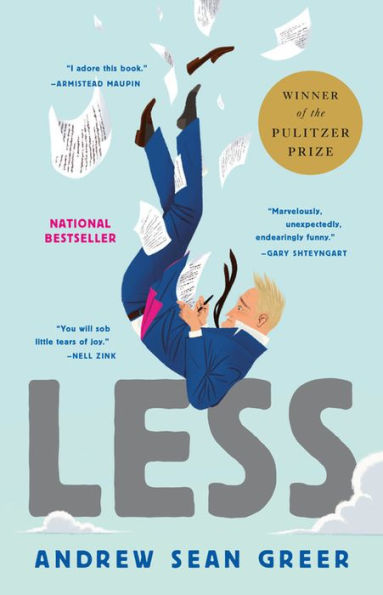
Less, by Andrew Sean Greer

Less was such an enjoyable read - I really loved every page, and I loved the way the story was structured with (Arthur) Less trying to outrun the marriage of his former boyfriend by traveling to all these different countries.  My favorite happened to be Germany, because Less suffers from a similar delusion as me - that he's very good at speaking a foreign language, although everyone responds to him with some amount of alarm of not understanding him.  There's even a line that perfectly encapsulates my own philosophy on speaking a foreign language.  "The key to speaking a new language,"she told them, "is to be bold instead of perfect."  That led to another bit that just slayed me:
He kisses--how do I explain it? Like someone in love. Like he has nothing to lose. Like someone who has just learned a foreign language and can only use the present tense and only the second person. Only now, only you. There are some men who have never been kissed like that. There are some men who discover, after Arthur Less, that they never will be again.
Swoon!

Another part that I thought about for a long time was this:
... As an areligious WASP, he had no idea what to do about death. Two thousand years of flaming Viking boats and Celtic rites and Irish wakes and Puritan worship and Unitarian hymns, and still he was left with nothing.
It is such an interesting fact how difficult it is to process a death. You'd think it would be more of our muscle memory after our long histories. 

Much to my surprise, I found myself reading a love story - I haven't really read one in such a long time, and it was an absolute delight.  Mini Spoiler - I loved how the third person narrator slowly revealed his own personality and became a mystery and then suddenly it became very obvious who he was.