Showing posts sorted by relevance for query on beauty. Sort by date Show all posts

Thursday, January 04, 2007

On Beauty

I just reread Zadie Smith's On Beauty. I saw her speak once in San Francisco after White Teeth came out. Somebody asked her what she liked to read, and she said something like she didn't think it was really possible to read a bunch of books and retain them very well, that (if I'm remembering correctly) she just wanted to know one book really well. And she may have said (jeez, I have a terrible memory) that for her that book was Howards End, or perhaps I just made that up. Anyway, On Beauty is an homage Howard's End, which I haven't read myself, but am inspired to read soon.

Like White Teeth, On Beauty has a cast of characters, and no small focus on racial issues and diaspora. On Beauty is the one book of fiction I made time to read during my master's program - and glad I did, because it also focuses on a subject near to my heart: art. Two scholars, one a conservative, black, old school art historian (Monty Kipps) and the other a liberal, white, hard-core theoretician (Howard Belsey), find themselves at odds in the same small-town college. As a liberal myself, naturally I found Kipps for the most part reprehensible, although Smith does go to pains to give him good arguments. The Kipps' are rude to the help and never very likeable.

The extreme views held by both parties (bridged only by the familial matriarchs) offer a fascinating glimpse into the minds of these uber-intellectuals, while at the same time illustrating their foibles (Howard is as worried about premature ejaculation as he is about getting tenure.) Smith is obviously well schooled in art theory, and her analysis of various Rembrandt's work, as well as so-called traditional art history itself, is insightful. Howard contemplates The Sampling Officials of the Draper's Guild:

This is what judgement looks like: considered, rational, benign judgement. Thus the traditional art history.
Iconoclastic Howard rejects all these fatuous assumptions. How can we know what goes on beyond the frame of the painting itself? What audience? Which questioner? What moment of judgement? Nonsense and sentimental tradition! To imagine that this painting depicts any one temporal moment is, Howard argues, an anachronistic, photographic fallacy. It is so much pseudo-historical storytelling, disturbingly religious in tone. We want to believe these Staalmeesters are sages, wisely judging this imaginary audience, implicitly judging us. But none of this is truly in the picture. All we really see there are six rich men sitting for their portrait, expecting - demanding - to be collectively portrayed as wealthy, successful and morally sound. Rembrandt - paid well for his services - has merely obliged them.


Smith elegantly introduces time as a thematic element, using art to make her case - although the characters that appear in the book don't go through radical changes, they do change, and every minute. She writes:


... forty-three years ago, he was an uncultured, fiercely bright, dirty-kneed, enraged, beautiful, inspired, bloody-minded schoolboy who came from nowhere and nothing and yet was determined not to stay that way - that was the Howard Belsey whom the Staalmeesters saw and judged that day. But what was their judgement now? Howard looked at the men. The men looked at Howard. Howard looked at the men. The men looked at Howard.


What initially hit me as a rather oppressive redundancy suddenly became hyper-realism - each second, our perspectives change, because time has passed. As the novel progresses and reaches its stunning ending, this theme is beautifully expressed in one, final, very visual moment that made me really weep to have read such a great book.

Monday, December 24, 2012

Beauty Queens

Beauty Queens (2011) by Libba Bray is a hilarious novel about a bunch of beauty queens on their way to a pageant, whose plane crashes on a desert island.  I liked it so much that I don't really want to say that much about it.... it's a fun, feminist, romp, wherein the beauty queens transform from stereotypes of themselves to independent survivors thriving on an island against all odds.  I'll tell ya, I love nothing more than a survival story, it really captures my imagination to picture people (me?!?) getting by in the wild.  

Each surviving queen has a bit of a backstory - if I remember correctly, none of them was independently interested in becoming a beauty queen, most of them were doing it to satisfy a parent.  Not surprisingly, Bray includes a reality tv element (something tells me this woman is well schooled in ANTM and Honey Boo Boo and also I would like to meet her and become best friends) in the form of these guys who... I don't want to drop any spoilers because it really IS a fun read ... let's just say that some male characters are introduced, and the beauty queens are in danger, but one of the things I loved (tiny spoiler) is that the beauty queens never sit back and wait for a dude to get them out of a jam.

I guess this book is officially YA... I suppose it would be a fine book for YA readers, but categorizing it never entered my mind as I was reading.

Bray's cast of characters includes a couple of gay beauty queens, a beauty queen who used to be a boy, a deaf beauty queen and several beauty queens of color.  I loved that her book incorporated such a wide cast, putting all these women on equal footing and as equal contributors to the community they create on the island.  There's also a very strong anti-capitalism line, with repeated gags about commercialization and how the sale of so many products hinges on making women feel bad about their bodies or selves.
In school, they would tell you that life wouldn't come to you; you had to go out and make it your own.  But when it came to love, the message for girls seemed to be this: Don't. Don't go after what you want. Wait. Wait to be chosen, as if only in the eye of another could one truly find value. The message was confusing and infuriating. It was a shell game with no actual pea under the rapidly moving cups.
At book club, one of my friends picked up my copy of Beauty Queens, and thrust it in my face, saying, "Throw this out, immediately," (*gasp*) "and get the audio version, it's hilarious."  So, I have it on good authority that the audio copy is great, and read by Libba Bray herself.

Monday, January 29, 2024

Shadow Tag


I haven't read a single thing by Louise Erdrich that I haven't loved.  All of her books are so inviting and absorbing, even if they're deeply sad and heartbreaking.  
Shadow Tag is terribly sad - about a couple who can't get away from each other.  They bring out the best and worst in each other.  She is his muse, literally and figuratively - he's an artist who has painted her throughout his career.  His paintings range from objectifyingly perfect to humiliating images they don't want their children to see.  I really love fiction about art - and in this book, with the slightest details, you're able to imagine a body of work from this man and woman.  It reminded me of a few other novels that have grappled with real and fictional art like Zadie Smith's On Beauty or Dara Horn's In the Image.  Interestingly enough, both Smith and Erdrich refer to Rembrandt's paintings of his partner, Hendrickje Stoffels, with great affection and generosity toward the sitter.


The wife, Irene, is has an unfinished PhD thesis on the (real life) American Artist, George Catlin, who painting Native Americans in the early 19th Century.  One painting in particular that Erdrich refers to in Shadow Tag is "Mi-néek-ee-súnk-te-ka, Mink, a Beautiful Girl" or, "The Mink".  Irene teases an imaginary history (as far as I know) around the creation of this painting and its meaning to Mink's tribe (the Mandan), and then revisits and  corrects it, exemplifying the way native people's history is sometimes fictionalized for the sake of mere entertainment, obfuscating or hiding the real story for various reasons (well, generally to make white people look better). It frustrates Gil, the husband, that George Catlin, a white man, was able to make a lucrative career painting Native American people, while he, as a Native American himself, would limit his career with such a subject. 
Don't paint Indians. The subject wins. A Native painter himself had said this. You'll never be an artist. You'll be an American Indian artist. There will be a cap on your career. You'll only go so far. You'll set up expectations. Attract only one set of collectors. Look at Rauschenberg. He was Cherokee. Did he paint Indians? No.

These, of course, are Gil's thoughts, or perhaps intrusive stereotypes that have been impressed upon him in his life as a (successful) artist.  Erdrich goes on to write of Gil:

His technical mastery had pushed his paintings past the west and Southwest, into Los Angeles and Chicago, Phildelphia, Washington, and then at last into New York, but he had not made the big leap. He was still classified as an American Indian artist, or a tribal artist, or a Cree artist or a mixed-blood artist or a Metis or Chippewa artist or sometimes and artist of the American West, even though he lived in Minneapolis. 

Gil is actually "unrecognized" by any tribe, although his heritage is partly Native American.  By the way, isn't it amazing how Erdrich brings so much humor to this situation, despite these painful, repeated attacks on his ancestry/identity?  And speaking of Minneapolis, Gil often drives to the museum in the morning to sit in front of Rembrandt's Lucretia.  [Side Note: 1. Sitting with art for extended periods of time is a wonderful privilege and if you have access to a museum or location where you can visit great art the breadth of understanding you'll gain from the work and the impact it can have on your life is invaluable. 2. This painting of Lucretia involves the incredible portrayal of a person who is quickly expiring!  See also Judith Beheading Holofernes by Artemisia Gentileschi and a Caravaggio painting of the same subject, for example.] Without putting too much of a giant bullseye on it, after having finished the book, Gil's fascination of an image of a woman who sacrifices herself for her husband is not surprising.  

The book is actually not that much about these images, but Erdrich obviously has a really strong background or understanding of art and art history/theory to make it one of the many themes that resound in Shadow Tag.  I find it so exciting when my loves/interests collide so it certainly stood out for me.  


Monday, January 01, 2007

Kelly's Top Books in 2006

This year my top favorite books were:
In the Image, by Dara Horn
The World to Come, by Dara Horn
Special Topics in Calamity Physics, by Marisha Pessl
On Beauty, by Zadie Smith
A Girl Becomes a Comma like That, by Lisa Glatt

Actually, I'm re-reading On Beauty right now - next up is a book given to me by friend A.: Dave Eggers new book, What is the What.

What were your faves this year?

Thursday, April 12, 2007

Remembering Kurt Vonnegut

Far be it from me to be the only book blogger not to book blog about Kurt Vonnegut. I haven't read much of his work - Slaughterhouse Five, and it's been awhile, so I can't really write intelligently about it. I remember Player Piano better - very good dystopian future stuff. I saw him speak once when I was at Indiana University. I was dating this guy who was kind of all into appearances. And he had something else to do, but he wanted to pop in to the lecture by Vonnegut, probably just to say he'd been there. And I wanted to hang out with him, so even though I didn't know who Vonnegut was, I went along. It was in the IU auditorium, which is quite large, and Vonnegut (a Hoosier!) was up on stage all alone, all tweedy and beardy - he couldn't look more like a writer if he tried. The audience was packed. The appearances boyfriend got up to leave after five or ten minutes, but I was so enthralled with Vonnegut I hardly noticed him leave.

I'm putting Breakfast of Champions and Cat's Cradle on my mental to-read list.

Here's an audio of one of his lectures - this is from around the time I saw him speak. And here's a more recent lecture where he lays the hammer down on conservatives.

In other book news - just heard today that Michael Chabon has a new book coming out (May 1, 2007), The Yiddish Policemen's Union. I hope it's half as good as The Amazing Adventures of Kavalier & Clay.

I've been reading Middlemarch since - oh - December. I don't know when it's taken me so long to read one book. In my defence, it's dense, it's over 800 pages, and it was written two centuries ago. I'm loving it, but I keep thinking, wow, there's so many books to read, and this one's taking so long. It reminds me of this thing I heard Zadie Smith say once, that she thought it was better to know one book really well than to have read tons of books. That book for her was Howard's End, upon which she based On Beauty. Maybe one day I'll write a masterpiece based on Middlemarch.

I did break down and start reading another book at the same time - The Other Side of You, by Salley Vickers. So far so good, but two things annoy me. 1) It's shrink-sploitation, which I'm not really into and 2) it's written by a woman, but the POV is a man. Yelch. I really didn't intend to start it in the middle of Middlemarch, but I ordered it from England (why do they get paperbacks before we do?) with my Harry Potter, and they mailed it early.

Tuesday, September 11, 2012

NW

My review for Sadie Smith's new book - NW - is in the latest copy Newcity and available online.  I really liked it, although, I hate to tell you, not as much as White Teeth or On Beauty.  One thing I didn't mention in my review is that there is a repeated image of the fox in the city, which, without putting too fine a point on it, serves as kind of a reminder of the "wild" or "nature" finding and forcing its way into the environs of the city.  
I'm into foxes myself this year because there's a family of foxes on the campus where I work, and every once in a while, if you're lucky, you'll see one taking a nap or, you know, killing a rabbit.  I've never seen a fox in my life before, then, suddenly, it's like Wild Kingdom out there.  They're beautiful little animals and I'm mildly obsessed.  

Here's one of Smith's fox references.  In this bit, Leah's mother has just given her a hard time about not having kids and she's thinking about how all her friends are having children:

The problem seems to be two different conceptions of time. She knows the pull of her animal nature should, by now, be making the decisions. Perhaps she's been a city fox too long. Every new arrival - the announcements seem to come now every day - feels like a terrible betrayal. Why won't everybody stay still? She has forced a stillness in herself, but it has not stopped the world from continuing on.  [...] Leave all this! Let's be outlaws! Sleeping in hedgerows. Following the railway line til it reaches the sea. Waking up with that long black hair in her eyes, in her mouth. Phoning home from fantasy boxes that still take the old 2 pees. We're fine, don't worry. I want to stay still and to keep moving. I want this life and another. Don't look for me!


Monday, December 04, 2006

Unsuggester

LibraryThing has a new feature called the "Unsuggester" - you type in a book you love and it gives you a list of books you're sure to hate. What purpose this might serve I don't really know, but it's kind of interesting. I typed in Zadie Smith's On Beauty, which I'm re-reading right now, and, sure enough, it gave me a list of titles I don't want anything to do with, like books on Jesus and Christianity, a bunch of sci-fi by Herbert and Heinlein, and bad chicklit from Jennifer Crusie.

I also tested out the "Suggester" - or "good" books, according to LibraryThing. Using the same title, I got a list of books including some of my faves, like, Safron Foer's Extremely Loud and Incredibly Close and Frazen's The Corrections, and also books by author's I really enjoy like Arundhati Roy, Ian McEwan and Phillip Roth. It recommends The Blind Assassin by Margaret Atwood. I'm crazy about Atwood but I couldn't even finish The Blind Assassin. Surprises were The Accidental by Ali Smith, which looks like teen fiction (one of my fave genres), something called Cloud Atlas by David Mitchell and The line of beauty by Alan Hollinghurst, a book I've always been vaguely interested in.

Saturday, December 17, 2016

Swing Time

I saw Zadie Smith speak, shortly after White Teeth came out, in front of a relatively small crowd in San Francisco.  We were both in our twenties then, she's one year younger than me, and I was full of jealousy and awe for what she had accomplished, and how sophisticated she was, and how beautiful.  Someone asked her what she was going to work on next and she said she wanted to write a book like a musical, where people break into song, inconceivably, as people do in musicals. I wonder if Swing Time is that book, but with singing replaced by dancing.

I remain in awe, many novels later, and I love how her books have become even more thoughtful and contemplative. Swing Time moves slowly, and I read it that way, over several weeks, allowing myself to enjoy her phrases.  As in a recently article by Smith in The Guardian, What Beyoncé Taught Me, it's impossible to read without stopping to look up YouTube videos of people dancing. The book is intensely beautiful, and I often stopped to think about what it would look like if I drew a sentence, or what the movie version would look like.

I suspect that the style, told from the perspective of an unnamed narrator, is borrowed from some aspect of British literature, and, once again I curse my non-existent PhD in the same.  This perspective is distancing, and the reader feels closer to the narrator's best friend, Tracey, who's brilliant and talented and clever and mean.  She's Tracey's companion and dancing partner, the Ginger to Tracey's Fred Astaire, and they fall out as Tracey's star seems to rocket and she takes a more conventional turn, both of them more than a little jealous of the other's path.  The narrator works for a Madonna-like narcissistic mega-star later in life and her activities absorb the narrator's time and talents.  They make multiple trips to Africa, where the star funds a school for girls. Smith delves deeply into themes of racial identity in this area, where the black, British narrator of Jamaican descent is often considered white and American by her colleagues and friends there.

Our narrator considers herself a dancer and an actor (despite never really practicing those things beyond
her childhood) although not as good as Tracey, but she finally allows herself a little freedom near the end of the book.  At a drum circle at the school, everyone is dancing:
Eight drumming women later, even Mary-Beth had attempted a dance and it was my turn. I had a mother pulling each arm, dragging me up. Aimee had extemporized, Granger had historicized - mooonwalk, the robot, the running man - but I still had no ideas about dance, only instincts. I watched them for a minute, the two women, as they danced at me, teasing me, and I listened carefully to the multiple beats, and knew that what they were doing I, too, could do. I stood between them and matched them step for step. The kids went crazy. There were so many voices screaming at me I stopped being able to hear the drums, and the only way I could carry on was to respond to the movements of the women themselves, who never lost the beat, who heard it through everything. Five minutes later I was done and more tired than if I'd run six miles.
Like On Beauty, Smith ends Swing Time with deceptive simplicity, turning the final words in a book into, in fact, a world of possibilities - a beginning.

Tuesday, December 03, 2013

The Goldfinch

Donna Tartt inspires some real adoration in her fans.  I was 100% willing to jump on the bandwagon after reading some amazing reviews of The Secret History. Tana French cites Tartt as an inspiration and I'm crazy about her.  So, I read The Secret History this summer and to tell the truth, wasn't quite sure what all the fuss was about.   I have relatively fond memories of The Little Friend, which I read back in 2007 and wrote a really worthless review about.

So, anyway, still eager to fall head-over-heels, I read The Goldfinch.  Here's my review in Newcity Lit.  I thought parts were outstanding and over-all it was too long, to greatly simplify a not-so-simple book.  I love that she uses this actual painting as a jumping off point - creating a narrative around a (fictional) history of that work.  I suspect, although I honestly have no idea, that there was some really higher-level Marxism shit going on in the theory of this book but, ha! ha! I am not a Marxist expert!  Particularly near the end, she becomes extremely theoretical about spending time with art work and the capacity of an experience like that to change a person, but more than that, it seemed quite related to the ownership or possession or consumption of things of beauty that led certain people (wealthy ones!) to afford that experience.  Anyway, I would be much obliged if anyone with expertise in that area would like to weigh in.  Or I suppose I could break down and go read the wikipedia page on Marxism.  Ugh.

Also of note was epigraph she included that I had never read before:
We have art in order not to die from the truth.-Nietzsche
Whoa.   I need to think about that for about the next ten years 'til Tartt's next book comes out.
The Goldfinch (Het Putterje), 1654
Mauritshuis, The Hague

Anyway, the whole thing reminds me of this lovely article I read in Harvard Magazine about patience, and art, and looking.  By coincidence, it also features a small animal on a chain.
John Singleton Copley’s A Boy with a Flying Squirrel, 1765

Tuesday, April 08, 2008

Venus

It's not easy to read plays. For the most part, they're meant to be seen on stage, and reading them requires a lot of imagination, a different pace from novels, and a modicum of theatre know-how (I can't tell you how many times I've heard people read the character's name before the line).

But, I find reading plays very rewarding - particularly Shakespeare, which benefits from multiple readings, and plays that I want to see, plays that I saw once and want to recreate in my mind...

Venus, Suzan-Lori Parks' play about the so-called Venus Hottentot, is particularly challenging to read because so much is left to the stage directions, or what Parks calls "unconventional theatrical elements" in her note at the beginning. She differentiates between a rest and a spell, and there are frequent passages in the text that read just the characters names and no lines:
The Venus
The Chorus of the Spectators
The Venus
The Chorus of the Spectators
The Venus
The Chorus of the Spectators
The Venus
The Chorus of the Spectators

She also uses inventive spelling (it sometimes read like a text message) to indicate accents or perhaps pace - things that may or may not translate to the stage, but are interesting to read:
The Chorus of the Court
Outrage! Ssanoutrage!
(Order order order order.)


I thought these choices were quite interesting because the play is essentially about looking (if you're unfamiliar with the sad and true story of Saartjie Baartman, she was an African woman who was essentially kidnapped and taken to Europe where she was the object of various vaudevillian/circus freak shows. People paid to look at her and extra to touch her. Even after she died, her pubic area was kept on display in a museum and only buried after repeated appeals from her own country and people.) From an academic point of view, the Venus is really a classic case of the objectified woman - and, beyond that, an African woman. Parks explores this low-point of history and its many aspects - the "other", the non-humanizing, the hyper-sexualizing of the African woman, the pseudo-science applied to non-European standards of beauty, the complicitness of the crowd... the list goes on. I would be interested to see this show on stage one day. Has anyone seen it?

Wednesday, April 25, 2007

Middlemarch - first half

I'm about half-way through Middlemarch, by George Eliot (Mary Ann Evans). Something I love about Eliot is how funny she is, and sarcastic - and I find myself laughing out loud all the time.
"Oh, my dear, you are so hard on your brothers! It is the only fault I have to find with you. You are the sweetest temper in the world, but you are so tetchy with your brothers."
- "Not tetchy, mamma: you never hear me speak in an unladylike way."
- "Well, but you want to deny them things."
- "Brothers are so unpleasant."
Middlemarch is a small town, and the book follows the stories of several families within the town, as well as some political issues regarding, if I'm not mistaken, landlords and renters. The political aspect is the only part that's not really holding my attention. My favorite story line is of Dorothea, who finds herself in an unhappy marriage to Mr. Casaubon. What I find most interesting about Dorothea (Dodo - how perfect!) is that she constantly doubts her own intelligence - no doubt due to being raised by her fond but misogynistic Uncle, who consistently reinforces the idea that women are frail and less inclined toward serious thought.
"But there is a lightness about the feminine mind - a touch and go - music, the fine arts, that kind of thing - they should study those up to a certain point, women should; but in a light way, you know. A woman should be able to sit down and play you or sing you a good old English tune."
I hate to say those sentiments are not unfamiliar to me or the small community in which I was raised. A few posts ago I joked about writing an homage to Middlemarch, and more lately I've been thinking seriously about doing it. I think after I finish, I'll read Howard's End and try to figure out how Zadie Smith did it for On Beauty. Middlemartinsville? I think something's there... Anyway, I have such high hopes for Dorothea, and want to see her explore the possibilities of her mind (if you've read it, don't give it away!)

Another theme I'm enjoying is the acknowledgement of change. Two young men argue about whether painting or literature is the higher art:
"Language gives a fuller image, which is all the better for being vague. After all, the true seeing is within; and painting stares at you with an insistent imperfection. I feel that especially about representations of women. As if a woman were a mere coloured superficies! You must wait for movement and tone. There is a difference in their very breathing; they change from moment to moment."
Eliot seeks to prove the impossibility of capturing anything - just a breathe changes everything.

Saturday, August 09, 2008

Never Let Me Go

Never Let Me Go, by Kazuo Ishiguro, had me really excited for the first 20 pages or so. It reminded me of The Handmaid's Tale (probably my favorite book), in that it takes place in some other time. I gleefully prepared to watch it all unravel as I read, but, unfortunately, very little unravelled and it utterly failed to keep my interest.

I won't go into the story line, just in case a reader has it on their list (although, if I were you, I'd scratch it off). I know this book was highly reviewed, which is the reason I picked it up when I saw it in the bargain bin. But, it's the kind of book that makes me want to call up all the reviewers and say, "Really, Michael Ondaatje? You seriously think Ishiguro is 'One of the finest prose stylists of our time'? Really?"

Aside from going nowhere, poorly, two things bugged me more than anything.

#1. The word "carer" (as in, "one who cares"). The beauty of writing a dystopian novel is you can make up any GD word you want to. The repetition of "Carer" was almost as bad as Anne Rice and her bullshit (and inappropriately used) "anthropomorphic" again and again.

#2. The font. I never thought this would matter, but the font really made me nuts. It was so distracting. You know when you get to the end of a book, and there's a paragraph "On the Font"? And you're like, who gives two craps about the font? For this book I actually skipped to that paragraph about 4 pages in to see if it said, "This font was specially created to stop the eye for approximately 20 seconds each time the letters "g" and "y" appear in succession. It'll happen more than you can imagine!"

Post Script: I just found a review by Margaret Atwood herself on Slate. She gives away the farm, so be aware. She writes, "It's a thoughtful, crafty, and finally very disquieting look at the effects of dehumanization on any group that's subject to it." Really, Margaret Atwood? Really?

And some snarky editor over at the Guardian wrote a hilarious parody of Never Let Me Go:
...I realise now how lucky Tommy, Ruth and I were to be brought up in such surroundings. We even had a sports pavilion where we would go to chatter amongst ourselves. You may wonder why I mention these details, but such empty observations are the hallmark of the consummate prose stylist....It may strike you that I like to hint at truths. This is because I fear you might stop reading were you to guess that the story really was as predictable as it first seemed.

Monday, July 02, 2007

Howards End

I read Howards End because I was interested in how Zadie Smith used the 1910 novel for her own On Beauty. I'll have to save that comparison for another day. I wasn't expecting to enjoy Howards End, just to read it critically. I gave E.M. Forster's Passage to India a try many years ago and was so bored I couldn't finish. But Howards End was wonderful - it's the story of two women - Margaret and Helen Schlegel, liberal, early-feminists, and another family - the Wilcoxes - different from the women in almost every way. The book is very sympathetic to the women, and I found myself getting so indignant every time the Schlegel's encountered the Wilcox rudeness. Look what Forster has to say about the Wilcoxes:
Day and night the river flows down into England, day after day the sun retreats into the Welsch mountains, and the tower chimes: "See the Conquering Hero." But the Wilcoxes have no part in the place, nor in any place. It is not their names that recur in the parish register. It is not their ghosts that sign among the alders at evening. They have swept into the valley and swept out of it, leaving a little dust and a little money behind.

One of the themes of Howards End is the Home. Margaret repeatedly remarks that one of the downfalls of society is that so many people are nomadic - everyone rents, feeling no permanent homestead anywhere. This struck a note with me because several years ago we got ousted from an apartment we loved because it "went condo" as they say these days. The Schlegel's long-term rental also essentially "went condo" and they found themselves in a desperate search for a new home. The Wilcoxes had a home - Howards End, which was loved by the Wilcox matriarch but unappreciated by the rest of the clan.
Marriage had not saved her from the sense of flux. London was but a foretaste of this nomadic civilization which is altering human nature so profoundly, and throws upon personal relations a stress greater than they have ever borne before. Under cosmopolitanism, if it comes, we shall receive no help from the earth. Trees and meadows and mountains will only be a spectacle, and the binding force that they once exercised on character must be entrusted to Love alone. May Love be equal to the task!

Near the end, I feared I was being led through one of those awful, 19th century-ish British morality tales, but ultimately, I saw the book as a progressive look at the modern family and a tribute to the generosity of spirit.

Tuesday, July 27, 2010

Weight

I recently read Jeanette Winterson described as "one of the most brilliant writers in the English language" on a blog I read and respect so I picked up a few of her books from the library. I actually had quite a few of her books on my "wishlist" so it's about time I read her.

The first I read was Weight: The Myth of Atlas and Heracles, which is part of that "The Myths" series. (I love Margaret Atwood's The Penelopiad from the series.) In The Myths, authors are invited to tell or re-tell ancient myths, and Winterson tells the tale of Atlas, who was punished with holding the world on his shoulders.

In an introduction, Winterson writes about telling stories and the issue of autobiography:
Weight has a personal story broken against the bigger story of the myth we know and the myth I have re-told. I have written this personal story in the First Person, indeed almost all of my work is written in the First Person, and this leads to questions of autobiography.

Autobiography is not important. Authenticity is important. The writer must fire herself through the text, be the molten stuff that welds together disparate elements. I believe there is always exposure, vulnerability, in the writing process, which is not to say it is either confessional or memoir. Simply, it is real.

Later she leaves the story of Atlas and Heracles and writes:
I know nothing of my biological parents. The live on a lost contenent of DNA. Like Atlantis, all record of them is sunk... Spin the globe. What landmasses are these, unmapped, unnamed? The world evolves, first liquid and alive, then forming burning plates that must cool and set. The experiment is haphazard, toxic at times. Earth is a brinkmanship of breathtaking beauty and a mutant inferno. My own primitive life forms take a long time to web intelligence. When they are intelligent they are still angry.

Wow!

Ultimately, she brings the reader to the conclusion that the weight Atlas (and all of us) carry can simply be put down, if we choose. When she allows Atlas to unburden himself, the world doesn't come to an end, it hangs there without him. Winterson's re-telling of the story of Atlas undoes the story of an eternity of punishment and becomes a beautiful tale about letting go.

Sunday, October 01, 2006

The Dissident


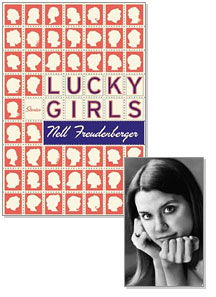
Nell Freudenberger's one of those hot new authors - gorgeous and brilliant and young. Her book of short stories, Lucky Girls, came out in 2003 to critical acclaim. I read it then and liked it, although I can't really remember it very well now. She sparked a lot of gossip from other artists and even the coined phrase, "schadenfreudenberger," which, as far as I can tell, means "an author you hope will suck but who, you must grudgingly admit, is actually pretty good." Guess who? Curtis Sittenfeld of Prep was one of the admirers who made that grudging admission in Salon, although it was obviously hard for her to do without mentioning the Iowa Writers Workshop over and over again and doing some serious name-dropping along the way.


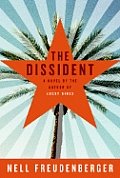
Freudenberger's latest (by which I mean 2nd) book is The Dissident, a book about culture clash in Los Angeles, when a wealthy family hosts a Chinese artist for a year while he creates new work and teaches art at an exclusive private school. The book bounces back and forth between previous events in China involving a group of performance artists and present events in LA. The interactions and creative process of the Chinese artists must be at least loosely based on the actual artistry of the Gutai Group, Japanese performance artists of the 1960s and 70s. Through conversation of the artists, Freudenberger raises (somewhat awkwardly) various questions related to performance art - such as who the author ultimately is (photographer or performing artist?) or what the art is (the photograph or the performance?).

A good deal of The Dissident has to do with cultural and racial interactions, as the wealthy (Caucasian) mother of the central family struggling to relate to both her Chinese guest, her son's less affluent, African American girlfriend, and an immigrant student at the private school in a politically correct way. This very struggle, or need to strive toward political correctness, illustrates her discomfort with those outside her social strata. Although a kind woman, this central character suffers in her relatively isolated world, unable to really connect with those around her.


Ultimately I found the plot rather dull and the soi-disant twist unsurprising. Many of the themes that Freudenberger slips into this book are explored much more fully and wonderfully in Zadie Smith's masterpiece, On Beauty, which is one of the more stunning books I've had the pleasure of reading in the past few years. Smith's deeper understanding of the artistic and racial issues led not only to greater insight into those important matters, but also to a much more satisfying read.

Monday, June 15, 2015

A God in Ruins

Kate Atkinson has written a delightful "companion novel" to Life After Life (my review). The 2013 Costa Award winner (formerly the Whitbread Award) was a challenging read, at least until you figured out the rhythm of things.  In comparison, A God in Ruins is child's play - or, better said, it's Atkinson doing what she does best: a rich, gothic tale of a British family.  This story is told from Ursula's sweet brother's POV, and it only has one timeline.  

There are a few little jokes re: Ursula's restarts which are rather amusing, like her saying "Life and death are completely random, that much I have learned." Her brother, Teddy, is such a great character - loving and warm and very very British.  He was a fighter pilot in WWII, and married Nancy, who you may remember from Life After Life.  They have a daughter, Viola, who is a stark contrast to her parents.  She's kind of a hippy, lives unhappily on communes and raises two children, poorly.  She's always snidely insulting her father about organic produce, etc, which, of course, he is no stranger to him, but he didn't grow up calling the food they grew in their own garden "organic".

Many parts of the book are actually super-exciting, and I had quite a few edge-of-my-seat moments, as if I was watching a wild action movie.  Her descriptions of Teddy's flight battles, near misses and a crash or two are so exciting.  Even though I've never seen the inside of one of these planes and what sounds like an impossible number of people squeezed into little cubbies here and there, it was so vivid.

Atkinson does not present the Allied soldiers as the sainted figures they are often portrayed as.  Teddy questions the indiscriminate bombing they do and grapples with what he's done in a way his few of his fellow surviving soldiers are willing to do years after the war.  "By the end of the war there was nothing about men and women that surprised him. Nothing about anything really. The whole edifice of civilization turned out to be constructed from an unstable mix of quicksand and imagination."

Here are some vocabulary words I looked up which I write here for your amusement and my own edification.  Will I remember them better now?  Who knows?  Below I will write some spoilers so read on at your own risk!

sobriquet - a nickname
entente - a friendly understanding
LMF - low moral fiber, acronym used during WWII
cauled - a type of cap
coup de foudre - an unexpected event. Literally, a bolt of lightening
tenebrous - dark, shadowy
braw - Scottish slang - good or fine. Derived from "brave"
widdershins - Scottish, in a direction contrary to the sun's course, considered unlucky
cadging - British - to ask for or obtain
au fait - having a detailed knowledge of something
pulchritudinous - I always think this word is the opposite of what it really means: beauty
spivvy - British - a man who makes a living by disreputable dealings
sprog - British, child
Far Breton


I have to say, the end of A God in Ruins hit me kind of like the end of Mad Men.  I was like GODDAMNIT! and SHE DID IT! and I was furious and exhilarated all at once.  As the walls fell down around Teddy and the horrible things Viola had done righted themselves and whole characters simply vanished all I could do was read in amazed, slack-jawed awe as Atkinson pulled on a string and unravelled the whole thing. What a fucking genius, honestly. In the author's note, Atkinson writes "I like to think of A God in Ruins as one of Ursula's lives, an unwritten one. This sounds like novelist trickery, as indeed it perhaps is, but there's nothing wrong with a bit of trickery."  She goes into a little bit of a lecture about the label of fiction and people's reactions to "new" styles:  "Personally I think that all novels are not only fiction but they are about fiction too. (Not, I don't think, as post-modernly self-referential as it sounds.) I get tired of hearing that a new novel is 'experimental' or it 'reinvents the form,' as if Laurence Sterne or Gertrude Stein or indeed James Joyce never wrote a word."  Later she writes "If this is a refutation of modernism or post-modernism or whatever has superseded post-modernism, then so be it."  Her defence of the style of her book feels pointed, and I'm not sure if I missed out on some literary spat or she just doesn't like being labeled.  I like what she says about all novels being fiction, and I think what she means by "they are about fiction" has something to do with creativity and creation itself. If anyone has any other thoughts, please share them!

Thursday, July 10, 2008

When You are Engulfed in Flames

When You are Engulfed in Flames is the latest book of short stories/essays by David Sedaris. I'm a big Sedaris fan, so I broke down and bought the hardcover, which I usually don't do, but I couldn't wait. Possibly it is better to wait for the softcover, but it's a very enjoyable read. Not nearly as laugh-out-loud funny as Me Talk Pretty One Day, but not as mournful as ... oh, I forget which one... where he writes about his mother dying.

I'd already read several of the essays in various other publications - The New Yorker and GQ and so on. Because they were great stories, I was thrilled to read them again. The best is probably "Cry Baby" about his seatmate on a plane crying throughout his journey. And the last third or so of the book is about his three-month trip to Japan to quit smoking. It's beyond self-indulgent, but that's also partly the point.

My favorite essays were the ones that made me laugh and then surprised me at the end by turning the table toward seriousness, like "Cry Baby" or "All the Beauty You Will ever Need" which address a certain view of homosexuality:
It's astonishing the amount of time that certain straight people devote to gay sex - trying to determine what goes where and how often. They can't imagine any system outside their own, and seem obsessed with the idea of roles, both in bed and out of it. Who calls whom a bitch? Who cries harder when the cat dies? Which one spends more time in the bathroom? I guess they think that it's that cut-and-dried, though of course it's not. Hugh might do the cooking, and actually wear an apron while he's at it, but he also chops the firewood, repaires the hot-water heater, and could tear off my arm with not more effort than it takes to uproot a dandelion.

You know what I find most curious about this book? At the end there's an "About the Author" paragraph which reads:
David Sedaris's half-dozen books have been translated into twenty-five languages, including Estonian, Greek, and Bahasa. His essays appear frequently in The New Yorker and are heard on Public Radio International's This American Life.
I just find that so odd. Do you think he wrote that himself? Bahasa? What the hell is that?

BTW, the cover art is from a less-well known painting by van Gogh - so, you see, he did have a little sense of humor!

Thursday, April 30, 2015

How to Build a Girl

One of the things I loved about Caitlin Moran's How to Build a Girl is that it's a real journey. Joanna makes a bunch of stupid decisions and most of the time acts like a total idiot, but in the true spirit of a bildungsroman, she's allowing herself the freedom to experiment, and, importantly: start over. The real beauty is that Joanna's journey allows the reader to see the full range of possibilities for any young girl (or boy, I suppose) and lands in this very open-arms feeling toward experimentation in life.

While Joanna could never really be described as a role model (quitting school, lots of v. casual sex, drugs, etc) she's a child of wild imagination, determination and reinvention - what amazing qualities to find in any character, much less a real-life person.
All my life, I've thought that if I couldn't say anything boys found interesting, I might as well shut up. But now I realize there was that whole other, invisible half of the world--girls--that I could speak to instead. A while other half equally silent and frustrated, just waiting to be given the smallest starting signal - the tiniest starter culture- and they would explode into words, and song, and action, and relieved, euphoric cries of "Me too! I feel this too!"
The story of Joanna is quite similar to Moran's own bio - a young woman from Wolverhampton grows up in a "council house" (that's like subsidized housing in the UK, I guess) and becomes a successful rock critic as a teenager. Moran goes to some pains to illustrate that this is a work of fiction, which I merely note because I'm obsessed with art that borrows heavily from the artist's life, and I also have the radical idea that we shouldn't label book types. (Alphabetical by Last, à tute!) See my review of The Wallcreeper for more of my V. Important Thoughts on this subject.

Just as I lol'd and hell yeah'd through How To Be a Woman, so too did I alternately lol and nod in sage agreement with Moran's spot-on assessment of girls' growing up in the 90s. Another theme, near and dear to my heart, is the role of the critic. Joanna finds it more fun to eviscerate the bands she reviews, until she realizes that her "bile-filled persona" makes working-class kids like herself feel ashamed of the thing they love. "I started writing about music because I loved it. I started off wanting to be part of something - to be joyous. To make friends. Instead I've just, bafflingly, pretended to be a massive arsehole instead." I've had a similar trajectory in writing book reviews - long ago I found it easier and more amusing to write what I thought was a devastating review - but for the last few years I've tried hard to write about the positives, even of books I hate. It's harder and it's not as fun, but I'm not spewing infective into the world. I love reading, and the idea of other people finding what they want to read. I never want to stand in the way of that.

I am also not ashamed to admit I learned some new words (and not just for my special lady area! In one glorious page she referred to her "wedge", "fnuh" and "toilet-parts") Here are a few I picked up:
Frangible
ontic
ignominy
Hebridean
Blag
loo roll*
Moran writes, "So what do you do when you build yourself-only to realize you built yourself with the wrong things? You rip it up and start again. That is the work of your teenage years - to build up and tear down and build up again, over and over, endlessly, like speeded-up film of cities during boom times and wars." Even though she specifies that it's the work of "your teenage years" I'm not so lucky to be finished yet. But this book gives me confidence to keep working on that girl.


*Meanings
Frangible: Fragile
ontic: of or relating to entities and the facts about them
ignominypublic shame or disgrace
Hebridean: people from some islands off Scotland
Blag: To obtain something by dubious means - I wish I knew the derivation...
loo roll: Toilet paper! Isn't that the best?

Friday, May 05, 2017

The Handmaid's Tale

I wish I could remember the first time I read The Handmaid's Tale (I remember how it made me feel, just not when it was). It must have been approximately 20 (!) years ago and, conservatively, I've read it at least 5-6 times.  It is My Favorite Book.  Margaret Atwood is My Favorite Author. And it is this book against which I judge all books.

It's recently come to my attention that not everyone KNOWS about The Handmaid's Tale book (WHAT) so, a brief synopsis: written by Canada's National Treasure, Margaret Atwood, who didn't include any details in this dystopian fiction that didn't have a historical precedent. The Handmaid's Tale is about a woman, Offred, living in Gilead in the former United States.  Handmaids are fertile woman who are impregnated for leaders of the Gilead community because a variety of causes have led to widespread infertility. 

I reread it last weekend because it's been a few years and also the show is on Hulu and also we're living in a dystopian nightmare and also why not.  Every time I read it I find something new, and, as I get older, the way I engage with it changes as well.  This time I noticed the repeated motif of eggs - how many eggs Offred eats, how she notices eggs, how she is a walking ovum, ready to be fertilized.  Atwood spends an incredible page and a half describing Offred's soft-boiled egg breakfast. They are words of singular beauty and elegance.

Earlier this year I saw this tweet that really made me laugh but is also true:
Offred isn't waging a revolution - she wants to survive and stay alive, so she's not sticking her neck out.  What's interesting in Offred's point of view that she knew what life was like before (similar to life now) and is experiencing the first wave of this new society.  The Aunts keep telling them "This may not seem ordinary to you now, but after a time it will. It will become ordinary."  I think one of the reasons people are so drawn to this book at this time in history is how quickly and quietly the citizens of the US rolled over and allowed the new regime to take over - first everyone was eager to allow for decreased freedoms in the wake of a terrorist account for the sake of "safety" (as we saw after 9/11) and then there came a point when protesters were simply killed - a terrifying tipping point of which the precipice feels ever closer.
image from the 2017 Women's March

There were hardly any notes in my 1986 hardback, signed (!!!!) edition (maybe 3rd?), but I tentatively put some in, in pencil, after explaining to M that it was my most prized possession and needed to be pulled in case of fire (my fiction books are obviously organized by last name.)


A Few Spoilers Below

One of my favorite parts of the book is the end, the "Historical Notes" which I didn't read for a few days after finishing the book the first time because I thought they were just the sort of boring notes that are sometimes included at the end of a book.  While the entirety of the preceding pages is from Offred's POV, suddenly the language and tone changes abruptly to some time in the future (the year 2195, actually) at a keynote session at a conference in Nunavit (Northern Canada) where is is revealed there are "Gilead" and "Caucasian" studies, those concepts being, presumably, inexistent by that time.  The speaker discusses the difficulty in authenticating the narrative (contained on a series of cassette tapes, in a bit of charming anachronism), and with what feels like agonizing academic distance, considering what we've just gone through with Offred, discusses the possible fates that awaited her, if indeed the tapes were truly authentic.

What jumped out at me this reading was how the male speaker, presumably of Inuit heritage (his name is Professor James Darcy Pieixoto), in the year 2195 (for fucksake), is still subtly undermining the female experience.  For example, he says that the title is a pun, "... having to do with the archaic vulgar signification of the word tail, that being, to some extent, the bone, as it were, of contention, that phase of Gileadean society of which our saga treats."  Similarly, he refers to "The Underground Femaleroad" as "The Underground Frailroad."  What Atwood does, again and again, is remind the reader there is no safe place. Inuit academics several hundred years in the future are not benevolent truth-tellers, they are just slightly sympathetic historians who crack dumb jokes. All women are not victims in this story - some women are the horrible propagators of terror and state-sponsored rape.

Throughout Offred's entire awful experience, her most violent reaction is to the sight of Aunt Lydia.  Not learning about her mother's death, not watching a child taken straight from a women's vagina to another woman, not seeing people hanging in the streets or the nauseating "Salvaging" in which the handmaids are forced to share complicity with netted punishment.  "I've begun to shiver. Hatred fills my mouth like spit."  That's what the sight of Aunt Lydia does to her.  I think it's the active cruelty of Aunt Lydia to the handmaids, specifically as a woman to other women, that causes this visceral reaction in Offred.  Cruelty of women towards women is a not uncommon theme in Atwood's books, and it serves a cold reminder that, unfortunately, some women don't support their sisters they way they should.  The side-effects of a paternalist society, say I - although I'm not entirely sure Atwood would agree with me.  For a long time, Atwood was reticent to call herself or the book "feminist" (although I think she's finally come around on that) and she certainly doesn't like to refer to the book as "science fiction" but rather "speculative fiction."  Fair enough, she's 77 years old and she's written one of the greatest books of the 20th century.  She can do what she wants. 

Thursday, December 27, 2012

Top 5 Books of 2012


These are what I published in Newcity... I have some other top 5s there that *I* think are amusing.

Top 5 Books (published in 2012)
NW” by Zadie Smith
A Hologram for the King” by Dave Eggers
The Age of Miracles” by Karen Thompson Walker
HHhH” by Laurent Binet
Treasure Island!!!” by Sara Levine


I read Junot Diaz's This is how you Lose Her after I wrote that.... I really it belongs on the list.  I suppose I might bump Treasure Island!!! to get it on there.

But, my Top 5 Books I Read (Not necessarily published in 2012) were:
The ColonyJillian Weise
Swamplandia, Karen Russell
A Hologram for the King, Dave Eggers
The Age of Miracles, Karen Thompson Walker
The Marriage Plot, Jeffrey Eugenides


Top 5 YAs I Read (Not necessarily published in 2012):
SpeakLaurie Halse Anderson
Why We Broke Up, Daniel Handler
Beauty QueensLibba Bray
The Absolutely True Diary of a Part-Time Indian, Sherman Alexie
Little Brother, Cory Doctorow