Wednesday, May 02, 2012

Little Brother

I encourage everyone to read this great YA book by Cory Doctorow called Little Brother.  It's a about this kid (16 or 17) in San Francisco in the not-so-distant-future.  Marcus's world has a bit more surveillance than our world - in school, all students are issued computers that track their keystrokes and look for specified keywords.  The walls are lined with "gait recognition" cameras that try to match up gaits to people and track movement.  Everyone is tracked by arphids too.  Marcus is a hacker, and knows his civil rights really well too - when the principal calls him into his office to grill him about a recent campus hack, he plays it cool, asks the principal if he has an evidence and encourages him to call the police and his parents.

When Marcus and his friends are running around town playing a game, there is a terrorist attack on San Francisco and they are gathered up as suspicious characters.  (I'm not telling you anything that's not on the back of the book).  Marcus's cool responses don't work with the Department of Homeland Security - using post-9/11 legislation, they don't have to follow the same procedures as the principal.  Marcus is tortured, certainly never gets a call to his lawyer, or is ever charged with anything.  When he finally is released, he decides he'll do what he can to take the DHS down himself.

What's interesting is that, in a manner of speaking, Marcus becomes a terrorist after being released from the DHS, even though what he's doing is ostensibly for the good.  What I found endlessly fascinating is that (almost?) all the technology Doctorow mentions in the book is either existing today or not a far stretch.  I frequently found myself asking my guy, "Is TOR a real thing?"  It is.  "You ever heard of Thomas Bayes?" Yep.  "How does DNS work?" It's complicated.

Little Brother has a great story, but the didactic side is what I loved.  This book challenges the reader to consider how they feel about privacy and how far they would be willing to go to protect it.  It encourages readers to become more savvy - and it's really empowering:
If you've never programmed a computer, you should.  There's nothing like it in the whole world.  When you program a computer, it does exactly what you tell it to do. It's like designing a  machine - any machine, like a car, like a faucet, like a gas hinge for a door - using math and instructions. It's awesome in the truest sense: it can fill you with awe.
It's so fun to read a book about a city you know well - I used to live in SF, and a lot of the action takes place in my old neighborhood (affectionately known as the Tender-knob).  Marcus is a cool kid - he's a nerd, but this accessible book would appeal to both nerds and non-nerds (that term is also affectionate, by the way) - I would think this book would really inspire young people to start some interesting web searches - it definitely did for me!

Doctorow is a real revolutionary and an anti-DRM, liberal copywrite activist.  His wikipedia entry is a great place to learn more about him.  As a proponent of Creative Commons, Little Brother is available as a free download here.  Wow!  Why does he provide his books for free?  Read this.

Saturday, April 28, 2012

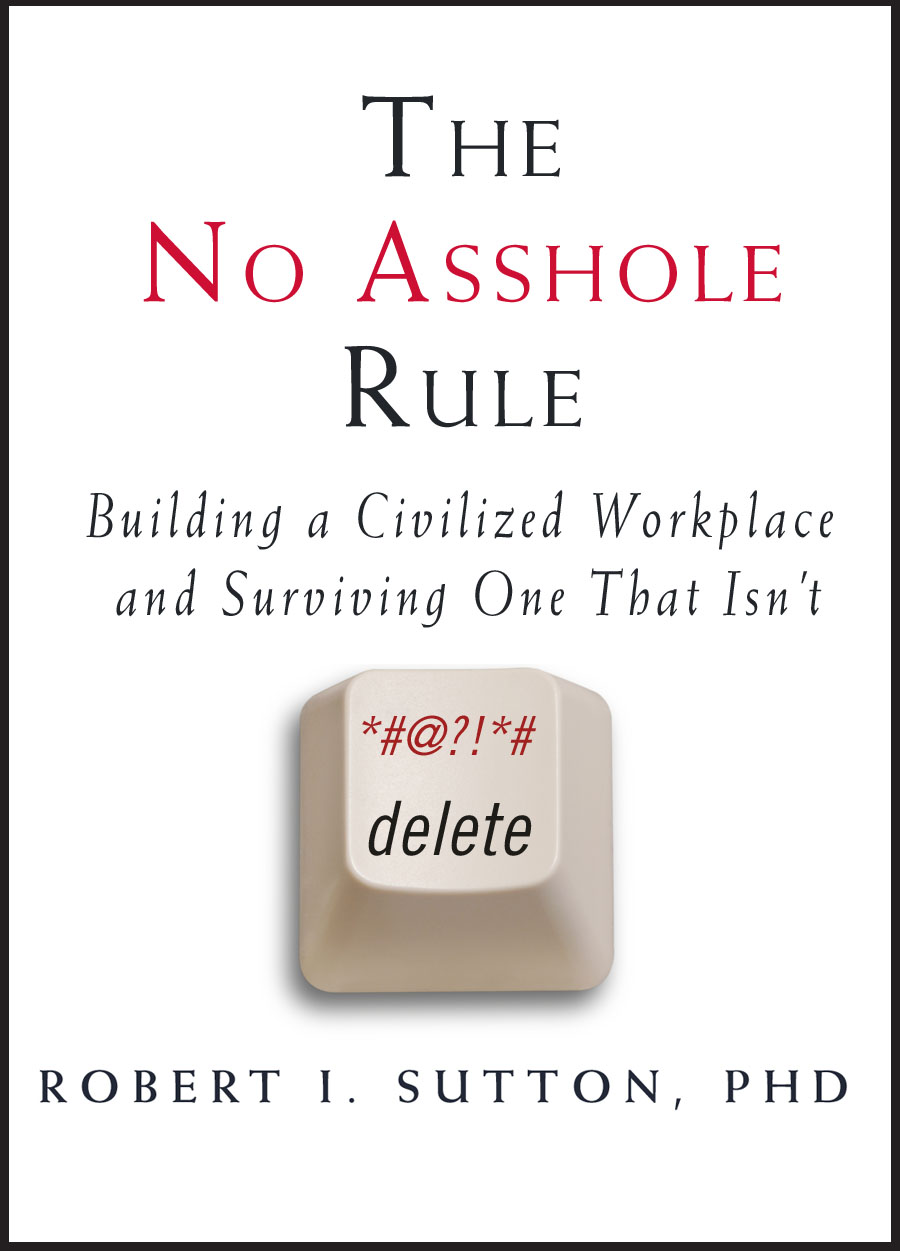
The No Asshole Rule

The No Asshole Rule: Building a Civilized Workplace and Surviving One That Isn't is a book based on author Robert Sutton's article in the Harvard Business Review - one of the anual "Breakthrough Ideas" of 2003 (the book was published in 2007).  


Sutton spends a lot of time setting up the premise - there are a lot of assholes out there, and they make workplaces miserable - from decreased moral, high use of sick time, decreased productivity to mental collapse.  It's bad.  Why're are there so many assholes?  I don't know.  His premise is simple: try not to hire assholes.  


His use of the word "asshole" is partly strategic, part cop-out.  He uses the term humorously, and, it IS fairly amusing to the see this mostly harmless curse word in every other sentence.  An asshole, by Sutton's definition, is someone who consistently acts like a jerk, "who belittles and demeans others in the workplace independently of gender, race or religious beliefs."  That's important - treating someone differently based on gender, race or religious beliefs (as well as sexual orientation) is illegal.  Being as asshole isn't.  So, when Sutton talks about managers removing "assholes" (by his definition), it's not entirely clear what he means.  As far as I know, you can't fire someone for being a jerk.  


As a hiring manager myself, I think I do a good job of finding people I want to work with (ie, NOT assholes), but, I must admit, I was more interested in this part of the title: Surviving One That Isn't.  I wasn't at all surprised to see that Sutton works in academia (also where I am).  I think most people would agree there are a disproportionate number of unpleasant folks in academia.  Just about daily I think about this old adage - Academic politics are so vicious precisely because the stakes are so small.  Sutton returns again and again to the "simple" solution if you're in an office populated by a-holes: just leave.  Well, sure, easy for him to say - but, that's pretty terrible advice in a bad economy (and not so great in a good one.)  His more "practical" advice is not much more helpful: Lower your expectations, "learn to feel and practice indifference and emotional detachment", "look for small wins" and "limit your exposure."  I frankly, do not want to to treat my work with indifference and emotional detachment - it's a part of my life - half of my waking day.  There's gotta be another answer, but it isn't in this book.*


I wouldn't really recommend this book to anyone, unless you enjoy reading shocking statistics and horrifying stories that may or may not be worse than your own.  He calls out a lot of people by name - some are well known, like Bobby Knight, other's less well - but I think all a matter of public record.  I'm thinking about passive-aggressively leaving the book laying around on my desk at work, but, if there's one thing I've learned, it's that Clueless People Are Clueless (it's true, there's a study and everything.)  One time at work this brochure went to everyone in the office that said to be aware if your behavior caused other people to, for example, back away, or avoid eye contact, or to cross their arms, etc, and I had a laugh with a friend about how many people it defined to a T, and then we got really sad because we realized it would take nothing less than a lightening bolt from the sky for someone to read that paper and say, "My God!  This is ME!  I need to change my evil ways immediately!"  


*Actually, there was one small bit of advice that I did like.  Sutton quotes a woman who uses advice from a white-water rafting instructor - if you fall out the boat, rely on your life vest - lay back with your feet in front of you and use your legs to bounce off the rocks.  In nasty meetings, the woman would literally stick her feet out under the table and imagine she was gently pushing off the offensive actions around the table. That's a nice visual I can work with!  

Monday, April 23, 2012

Monday, April 16, 2012

No fiction winner for Pulitzer this year!

Wow, the Pulitzer prizes were announced today and there was no fiction award!  Shocking, huh?  Swamplandia, by Karen Russell (I've really got to read that soon!), something I've never heard of called Train Dreams by Denis Johnson, and The Pale King (by Foster Wallace, which I have no intention of reading)  were short-listed.  I wonder what gives?  Apparently this hasn't happened since nineteen-seventy-something.


Sunday, April 08, 2012

Cringe-worthy

There's a great article in the Awl that interviews a bunch of folks in the book-industry: 
What Books Make You Cringe To Remember?  As you might expect, there's a lot of Ayn Rand on the list.  I have to say, that's what I would put on my list too - I LOVED The Fountainhead when I was a teenager.  I might also put Flowers in the Attic on the list...  

Quite a few people mentioned On the Road by Kerouac - that was a bit surprising to me.  However ridiculous and misogynist the Beats might have been, they exemplify this pretty interesting part of American history.   Someone mentioned Sweet Valley High!  Now, how could you regret Jessica and Elizabeth?
 

But, even though they make me cringe a little, I don't regret reading them.  I think the books we read help us become who we are.  


Maureen Corrigan from NPR says it well:

I've been wracking my brain, but honestly it's hard to suggest any without feeling disloyal. In fact, at the risk of sounding sentimental—oh, what the hell, I'll be sentimental—to dis those embarrassing young adult faves now feels like snickering at the friends I had in high school and college whom I've "outgrown." I loved them and needed them at the time and, for that, I'll always be grateful to them.
Anybody have some cringe-worthy books they'd like to share?  

Sunday, April 01, 2012

Nightwoods

I hadn't planned to read Charles Frazier's Nightwoods (2011), but it called my name as I was browsing the "New Books" alcove at the library where I work.  I'd read his Cold Mountain many years ago and wondered how things had progressed for him.  I thought Cold Mountain was beautiful but dull. 


Nightwoods was absolutely captivating.  I could literally barely put it down - I like to read at bedtime and I would try to read well after I should have gone to sleep, trying to keep my drooping eyes open. 


His prose is so beautiful.  I had just read this novel with kind of forced, over-the-top prose (The Book of Madness and Cures) and reading Frazier's effortless, lovely language kind of washed that previous book out of my brain.  I wish I could examine the structure and tell you how he did it, but, to my great shame, I've never taken so much as one literature class, so, I have no idea.  It's magical.  Like Marilynne Robinson only more plot-driven (thank God!)  
Done carefully and with luck, maybe a flame no bigger than the tip of a finger lives for a few seconds.  Then, when the tinder begins to catch, an old man with his long hair on fire, crumple a few more whole leaves and place twigs above the flame. Nervous as pick-up sticks in reverse. Judge wrong, the sticks collapse and snuff the flame. Do it right, and the flame grows, but still fragile. More twigs and then small broken branches. And when that layer starts to catch, that's when you purse and blow. Do it on and on until, when you look up to the sky, everything is dark and grainy as soot with little silver sparkles dancing in your vision. For there, it's easy. nothing but the architecture of broken wood. 
A woman, Luce, lives alone as a caretaker for an old, closed, resort lodge.  She makes little money and supports herself with a garden and listens to the radio.  She likes being alone.  But, her sister is killed by her husband and her sister's children are sent to her.  The children have been damaged by what they saw and what was done to them, they are like skittish animals, which Luce carefully tries to coax back into the world.  They don't even speak.  The story is alternately told from the perspective of the murderous husband, who is trying to find the children.  His pathology and justifications are really chilling.  He lives with violence, but is a charming schemer.  


You might be able to think of half-a-dozen Lifetime movies that have that same plot, and, as I was reading, something in the back of mind kept telling me how annoying  it would be if it wrapped up the way those movies end - surprise, unknown strength, unexpected gratitude, mute children suddenly talking, what a relief, etc.  Thankfully, he's a much more skilled writer than the folks who are throwing those movies together!  

Here's one of those stupid book trailers, slightly more stupid that usual.  I include it only because I think they're bizarre and publishers still seem to be working out the kinks. Also this one in particular  kind of sets it up like a Lifetime special, with an odd focus on FIRE! (the children, like most kids, like catching things on fire.)  

Thursday, March 29, 2012

The Book of Madness and Cures

My snarky review of The Book of Madness and Cures by Regina O’Melveny in Newcity.  It's got nice cover art, though.


Sunday, March 25, 2012

Wyrd Sisters

A friend of mine recommended Terry Pratchett to me - I've never read his books, but I'd recently seen Hogfather with a certain husband. The movie was half-really-good and half-really-terrible, made slightly more interesting because Lady Mary from Downton Abbey played the granddaughter of Death.  Anyway, Pratchett wrote the novel (or novels? I'm not sure) upon which it is based.


Wyrd Sisters (1988) takes place in Discworld, the universe Pratchett has created.  Discworld is like Earth with a sharp tilt - magic and sorcery and fairy tales are part of the reality.  It's sort of like a grown up Harry Potter (I suppose Discworld fans would want my head for that because it looks like he's been writing this series since the early 1980s...)  The best part about the book is that it takes it's cues from MacBeth - it's about a king who is killed by a Duke (a strategic move masterminded by his power-hungry wife), and nearby, three witches become involved in the political strategies in order to help protect the village and the local environment.  It also involves a little Hamlet as well, but that's more subtle.  It was all very amusing for a former Shakespeare scholar like me.  Why, I, myself (have I ever mentioned?) played one of the three witches in college in my Shakespearean drama course, part of my, career-wise, completely useless undergraduate degree in Theatre, but, I think, quite useful for like, life in general.  

All that sounds mildly stodgy and boring, but, let me assure you, it's very, very funny.  I think it's so hard to write truly humorous literature, but, I have to hand it to this guy, he's laugh-out-loud funny.  Incredible wit, and at the same time, a smart critique of story-telling and history.  Guided by his Fool, who is actually something of a genius, the Duke decides to literally re-write history by having a play written about what happened to the previous king.  Enter a band of actors (who are also building a theatre called The Dysc:  "It's got to be a name that means everything," he said. "Because there's everything inside it.  The whole world on the stage, don't you see?"*

I have to admit, some parts I did find slightly annoying - there were a few characters I didn't like, so I found myself skipping pages occasionally, but I absolutely loved the Shakespearian comparisons.  A running theme, for example, is that the Duke/King is forever trying to clean his hands of the blood from the murder.   "He'd scrubbed and scrubbed, but it seemed to have no effect. Eventually he'd gone down to the dungeons and borrowed one of the torturer's wire brushes, and scrubbed and scrubbed with that, too. That had no effect, either. It made it worse. The harder he scrubbed, the more blood there was. He was afraid he might go mad..."  Remember Lady MacBeth's famous "Out, damned spot!" scene?

If I had discovered this series when I was 15 or 16, I probably would have gone completely bananas.
All the Disc is but an Theater, he wrote, Ane alle men and wymmen are but Players.  He made the mistake of pausing, and another inspiration sleeted down, sending his train of thought off along an entirely new track.
   He looked at what he had written and added: Except Those who selle popcorn.
   After a While he crossed this out, and tried: Like unto thee Staje of a Theater ys this World, whereon alle Persons strut as Players.  This seemed a bit better.
  He thought for a bit, and continued conscientiously: Sometimes they walke on. Sometimes they walke off.  

* If you're not a theatre nerd, this is a delightful reference to The Globe theatre.  

Thursday, March 22, 2012

Tournament of Books!

Update on the Tournament of Books... I saw my dad creating one of these... bracket things (?) for what I believe was recent basketball activity.  I have only read two of the books in the tournament, but there are quite a few others I'm interested in (The Art of Fielding, The Sense of An Ending, and Swamplandia).  The two books I have read happened to be against each other - The Marriage Plot vs. Green Girl - surely quite randomly as they have little to do with each other in basically any way.  I thought Edith Zimmerman's judging was hilarious and the "Match Commentary" rather astute.   Obviously The Marriage Plot comes out on top, but I do think it's a very odd pairing.  Maybe that's how these bracket things (???) work for all I know.

via

Then I noticed Zimmerman interviewed Zambreno on The Hairpin.  It was only partially awkward because Zimmerman like, straight-up said she didn't like the book, but then they managed to have a nice conversation.


Bracket thing


Monday, March 19, 2012

Tuesday, March 13, 2012

Orange Prize Longlist

The Orange Prize Longlist has been announced and there are some great looking books on it.  I find it to be a consistant indicator of excellent women writers.

I've only read one book from the list - The Forgotten Waltz, by the inimitable Anne Enright.  I've been hearing good things about The Night Circus by Erin Morgenstern and I've been meaning to read some Emma Donoghue.  Looks like this list might be a good resource if you're looking for something to read!

via

Monday, March 12, 2012

"Unspeakably irritating"

Apparently Jonathan Franzen critized Twitter by saying it was the "the ultimate irresponsible medium."


The full quote is:

“It’s a free country. People can do whatever they want within the law, and even some things not within the law…I personally was on Facebook for two weeks as part of a piece of journalism I was writing — it seemed sort of dumb to me. Twitter is unspeakably irritating. Twitter stands for everything I oppose…it’s hard to cite facts or create an argument in 140 characters…it’s like if Kafka had decided to make a video semaphoring The Metamorphosis. Or it’s like writing a novel without the letter ‘P’…It’s the ultimate irresponsible medium.
In response, some folks on Twitter have been posting to #jonathanfranzenhates, mostly proving his point but there are some funny lines, like:

 the moon.Its light is unspeakably dishonest + no more than a reflection

 Wordprocessors. *Real* writers etch their words onto the parchment through quills filled with their own blood & saliva

 Emoticons, because it takes 600 pages to accurately convey emotion.

  Jennifer Weiner. Or is it the other way around?


Monday, March 05, 2012

No Kids

I remember when Corinne Maier's book, No Kid: Quarante Raisons de ne pas Avoir d'Enfant, was published in France a few years ago, there was something of an outcry in the states, even though it was in French and wasn't even available here.  I also remember thinking: I wish my French was a LOT better.  


As someone who does not intend to have children, I found (the English translation of) No Kids: 40 Good Reasons not to have Children absolutely delightful.  Maier is an instigator, and a lot of the time she's just digging for a fight, but, it's true that this world  is made for rewarding people with kids, while families without kids are viewed as bizarre anomalies, something to be either pitied or looked at askance.  If you don't believe me, I would be happy to regale you with hilarious stories of moronic things people have said to me over the years, viv as vis my childlessness.  (I prefer childfree, and was mildly disappointed to see the same term in Maier's book - I thought I had invented the term!  But, see, that's just how rare we, the childfree, are.)

Each short chapter expands on her good reasons not to have kids, like "You keep your friends" and  "Kids are the death knell of the couple" and "Don't revert to childhood" and "Motherhood is a trap for Women."  What's kind of interesting is that Maier actually HAS kids, so she offers a unique perspective on the topic - that rare person that's actually willing to admit that having kids is not as much fun as it's cracked up to be, and that she often actually regrets having kids (I've NEVER heard an American say that!)  Shocking as it may be to hear someone disparage their own children in print, I think it's worth keeping a level head and remembering that while her thesis is meaningful, some of her methods are clearly satirical.

I love cultural tidbits, so one of my favorite parts was about the term "Merdeuf", a mash up of mère de famille, which means mother of the family.  Of course, merdeuf sounds like "shit" and "egg" (merde and oeuf), so its slangily loose translation is "egg shitter"... a bit more bite than Soccer Mom, n'est-ce pas?

It's not entirely clear who Maier is writing this book for.  Partly it seems to stick it to parents ("Having a child is the best possible way to avoid asking what the meaning of life is, as everything revolves around that child, who is a marvelous substitute for the existential quest.")  Partly it's for people like me ("The famous glass ceiling stops women from getting the top jobs, and those jobs do have one great advantage: the higher you rise, the fewer idiots there are above you.  It is not astonishing that biographies of successful women never fail to note the number of children they've had: those are the obstacles they've had to overcome in order to make something interesting out of their lives.") But, for the most part, I think she's really an anti-capitalist.  What she returns to again and again is how children are a strain on resources, and are seemingly preconditioned to desire things.  She writes about how much pressure there is on parents to buy endless cycles of plastic shit for their kids. Like me, she fears a world with increasing population, fewer and fewer natural resources, a fairly horrifying unemployment rate, and an increasingly grim outlook for the next generation.


I wouldn't really recommend this book to any one who already has kids, in my experience most people find it necessary to defend their choice to have children when others merely state their choice not to.  They'd spend the whole book saying, "That's not true, I had fun just the other day!"  If you don't intend to have kids, or are thinking about the subject, like me, you might be gratified to see some of your feelings expressed in print for once, and at the very least have a really good laugh.

Friday, March 02, 2012

Ideal Bookshelf

A cool art project by Jane Mount, who paints people's "ideal bookshelves" (gouache & ink).  Speaking of drawings and books, I've been thinking of revitalizing my erstwhile idea to draw pictures from scenes in books I read.  Despite the fact that I am, in fact, a pretty terrible artist.  Last night I did a drawing/watercolor from Crossed, but it's so ugly I now consider it a "draft" and will try another version.

via

Thursday, March 01, 2012

Matched & Crossed

I listened to Matched "on tape" and recently read the second book in the trilogy, Crossed, on M's Kindle.  I merely mention it because those are slightly non-conventional reading methods and did have an influence on how I perceived the books.
They're YA books by Allie Condy, about a young girl (15? 16?) in the not-so-distant future who lives in a very controlled world where The Society keeps a close eye on everyone, regulates what they eat, drink, even regulates  dreams and decides when people die (on their 80th birthdays).  They choose marriage partners, and Cassia gets "matched" with her friend, Xander.  But then, like, somehow she's really matched with this other guy, Ky (to tell the truth I forget how that all worked... it's been a while) and, anyway, she sort of starts falling for Ky.

In the second book, Crossed, (Spoilers re: Matched here), Ky's been outcast to this other place so Cassia sort of outcasts herself to go find him.  A lot of the book takes place in the wilderness, which is a major change for these folks who've been basically eating nothing but TV dinners their whole lives.  The wilderness bits had an inevitable Hunger Games feel to them (which I rather liked) and I've been semi-developing a theory about young characters and the rejection of the structured environment.  But more on that some other day.

As everyone knows, when one is reading a book like this, one is constantly comparing it to that Standard Bearer of all Dystopian Novels - you know what I'm talking about - The Handmaid's Tale, by the great Margaret Atwood.  So, how does Condy compare to Atwood?  Not too bad...  She creates a really rich and engaging landscape for the characters.  I also really like how she uses poetry as subversion - Dylan Thomas's Do Not Go Gentle Into that Good Night and a few things by Emily Dickinson that I'm too lazy to look up.  The citizens of this place carry around pills that the society tells them to take at various points - that's very effective because they're a bit of a mystery, and the more Cassia questions the society, the more the reader questions those sneaky pills!

As far as YA books go, what I really loved about Crossed was how brave Cassia is.  She's a great role model for young women: question authority, use your head, trust your instincts.  Another nice aspect is that she's not getting saved by the male hero; she's a clear heroine in this story, not a helpless princess.  Here's Ky thinking about Xander:  "This isn't a game. He's not my opponent and Cassia's not a prize."  Hell yeah she isn't!  Eat it, Stephanie Meyer!  

Sometimes Condy's prose goes a bit blue, but I have a very high tolerance for that sort of thing - this is the only bit of alliteration abundance (see what I did there?) that made me roll my eyes: "Seeing the wind wave the water and brush the branches reminds me that, before I returned to the Society, I crossed over rivers and canyons."

The third book comes out this fall, and I'm looking forward to finding out how it ends!

Tuesday, February 28, 2012

The Count!

An organization called VIDA: Women In Literary Arts has an amazing project where they count up articles in popular press written by and about women artists.  They make some simple pie charts, like this one


that express their findings.  Here's a spoiler:  they all look like that, or have even less blue pie pieces than that one.  I had heard some pretty damning numbers like those a few years ago, and, it's one of the reasons I almost exclusively review books by women for the weekly magazine I write for.  Plus I just really like women writers.   Check out the rest of their graphs - it's pretty shocking!


via

Sunday, February 26, 2012

The Absolutely True Diary of a Part-Time Indian

We read The Absolutely True Diary of a Part-Time Indian, by Sherman Alexie, for book club.  I'd heard of Alexie through Selected Shorts - a podcast I adore - they're big fans of his.  It's a YA book about a young Spokane Indian boy who lives on a reservation in Washington State.  Arnold Spirit describes himself as an awkward, pimply teenager, who gets beat up on a regular basis by other kids and even adults on the Reservation.  A teacher encourages him to go to a school outside the reservation, at which point he starts to feel more hope for the future.  He faces almost unbelievable challenges like lack of food, an alcoholic father, his disabilities (he was born with Hydrocephalus), lack of transportation (our book club was shocked that the character claimed to often walk 22 miles from school when his dad was too drunk to pick him up or there wasn't enough money for gas).  He becomes a "part-time" Indian - at home, on the Reservation, he's a full-Indian - at school, he identifies with his most-white classmates - unable to completely fit in either world, he finds it necessary to navigate between these very different cultures and societal groups.

Arnold loves to draw, and the book is illustrated with cartoons that he created (artwork is by Ellen Forney).  The cartoonish drawings lend a graphic-novel aspect to the book, causing it at once to fly by quicker, but also to allow those interested in the images to linger over the little details.

What was most interesting was learning about life and culture on the Reservation  - a little-known way of life for many Americans, despite the fact that it's such an important part of our collective histories.  For me, this book was a little too boy-focused, and I got a bit bored in the more basketball-y parts - but I would highly recommend this book to any young reader (old enough to deal with the themes of death and alcoholism.  Side note: this book is frequently challenged in schools and libraries apparently because of a masturbation reference!)
Overnight, I became a good player.
I suppose it had something to do with confidence. I mean, I'd always been the lowest Indian on the reservation tomtem pole - I wasn't expected to be good so I wasn't. But in Reardan, my coach and the other players wanted me to be good. They needed me to be good. They expected me to be good. And so I became good.
I wanted to live up to expectations.
I guess that's what it comes down to.
The power of expectations.
What really emerged in our book club was how little we know about American Indians today, and what a shame it is that Indian history is not a part of our national dialogue - I think this book is a really valuable contribution to literature and society (no less!) for the insight it provides.

Saturday, February 18, 2012

Phone booth library

cool project in NYC to convert old phone booths into lending libraries. Reminds me of the cool converted magazine box in Logan Square.  Books for the people!  
via

Sunday, February 12, 2012

Why We Broke Up

My interview with Daniel Handler and Maira Kalman is on Newcity!  I really loved this book - it was so enjoyable and I fell in love with the characters.

One regret I have is using the word "morality" in my question about sex - I should have just said "message".  I have this occasional dumb habit of referring to out-of-wedlock-sex as an issue of "morality" even though I don't even BELIEVE that people who have unmarried sex are in any way immoral.  But, I was raised in a very religious household/community where especially teen-sex was inextricably seen as a question of morals.  It's dumb, but, for some reason it's stuck in my head that way.  It's funny how, when you learn something as a child, it is very difficult to un-learn it.  For example, my mom told us that if the car door opened while the car was in motion, the force of change in pressure would suck everyone out of the car where they would be smashed on the side of the road.  To this day I COMPLETELY freak out if a car door cracks open when the car's moving.  Anyway, it's just a lesson to me to think more carefully about my word choice and I wanted to put it out there that I do regret using that particular word.

They were fun to interview - it was nice talking about a book I really enjoyed with the author and illustrator, right after I finished reading it.  I'm a big Daniel Handler fan - if you haven't read him, check out Adverbs or, better yet, Watch Your Mouth.

BTW, the book has an accompanying tumblr which is kind of amusing - you can read about breakups by people of all ages or add your own.  I wish I had a good break-up story, but most of them were just like, I don't like you anymore.  Oh, except for that one guy I dated in college who I found out was married.  Then, I broke up with him.

Tuesday, January 17, 2012

A new pile

Picked up a nice little pile of books at my local thrift store - look at these treasures!
Three Carol Shields books that I hadn't even HEARD of - OMG, I'm so excited to read those.  That Guernsey Literary and Potato thing, two of those Clan of the Cave Bear books that I've been wanting to read ever since we saw those caves in France.  And The Awakening, by Kate Chopin - apparently a Must Read in the history of feminist literature.  

Right now I'm reading Great House by Nicole Krauss right now which is mildly challenging following the brain vacation I've been on recently.  

Saturday, January 14, 2012

Before I Fall

I got a nice handful of YA books from my Secret Santa (bro-in-law) at Xmas - Before I Fall (2010) by Lauren Oliver was the first one I read.  It's about a mean girl, Sam and her mean friends who are in a car accident after a party and Sam gets killed.  But, she wakes up and relives that day all over again.  And again.  And again.

The premise is compelling, and even though I really didn't like Oliver's writing style very much, I could barely put Before I Fall down.  I just wanted to find out what happened and what changed every time.   What I also found interesting was how Oliver humanizes the bully.  She doesn't pull any punches with Sam and her friends, who do some truly rotten things to the other students at their school.  As Sam relives the day over and over, she becomes more cognizant of how her actions are effecting those around her, but she doesn't turn her back on the Queen Bee and her best pal, Lindsay.  
Lindsay, with her angel's face and messy, dirty blond hair and chipped black nail polish and battered leather Dooney & Bourke bag that always has a film of tobacco and half-unwrapped Trident Original at the bottom.  Lindsay, who hates being bored, always moving, always running.  Lindsay, who once said -"it's the world against us, babes" - drunk and looping her arms around our shoulders when we were out in the arboretum and really meaning it.  Lindsay, mean and funny and ferocious and loyal and mine. p.346
Oliver explores elementary theory from a combination of Butterfly Effect, Schrodinger's Cat, and a wee bit of Quantum Physics, as any decent time-travel story naturally would.  I'm obsessed with Quantum Mechanics so I enjoyed those bits:
It amazes me how easy it is for things to change, how easy it is to start off down the same road you always take and wind up somewhere new.  Just one false step, one pause, one detour, and you end up with new friends or a bad reputation or a boyfriend or a breakup. It's never occurred to me before; I've never been able to see it.  And it makes me field, weirdly, like maybe all of these different possibilities exist at the same time, like each moment we live has a thousand other moments layered underneath it that look different.  (p. 285)
I saw Young Adult recently - a movie about another Mean Girl played by Charlize Theron who happens to write YA fiction (unironically) about Mean Girls.  That stood as an interesting comparison to this book, for me, largely because Theron's character doesn't really learn any Life Lessons and also because it brought full circle for me this rather new (am I right?) concept of the Mean, Popular Girl as fictional heroine.  It's like, this girl is popular, smart, beautiful, witty, has a ton of fun, learns some Life Lessons (unusally) and comes out on top.  In any event, I'm sure Before I Fall would be quite interesting to teen readers and any adult like me that likes reading YA fiction.

Saturday, January 07, 2012

The Goats

The Goats (1987) by Brock Cole had been popping up on my radar.  It seems to be one of those YA books that has an effect on people who read it as children, like The Chocolate War.  Like The Chocolate War, I somehow missed it when I was but a wee, moody, bookworm adolescent.  I suspect they hid books like these to keep us from getting ideas.  But it's just a suspicion.

In The Goats, two children are tricked by their summer-camp-mates into going to a small island, where they are briefly physically assaulted and then robbed of their clothing and left.  (An aside: my sister and I were talking about someone being assaulted within earshot of her 4 year old.  I thought he wasn't listening, but later on he spilled salt on the table, flicked it at us and said it was a' salted.)  The general idea, by the camp bullies, is that the two clumsy, unlovable outcasts would find humiliating solace in each others arms in animalistic, goat-like behavior.  The two children are, naturally, humiliated  and escape the island by swimming away and hiding out, with the intention of never returning to camp.  The girl calls her mother, who initially doesn't understand the urgency of the matter and refuses to come to the woods to pick her up.

What I found interesting as an adult reader was how Cole positions their youth and sexuality.  The children are pretty specifically pre-adolescent - the girl is described as having "[...] no breasts, just two shriveled nipples. At the bottom of her belly was a little patch of hair, like a Hitler mustache.  That meant she was more mature than he was.  He didn't have hair yet."  They spend about 3-4 days together hiding out and testing their capacity to live in the woods together.   They don't have anything approaching a sexual relationship, but their relationship is certainly sexualized.  "Covering" themselves, like Adam and Eve after The Fall, is first priority.  Of course, it could be that it's merely my interpretation of the book as focusing on their pre-sexual interactions.  The (adult?) reader is perhaps (more) aware of the children's ever-present consciousness of their sexual fragility.

The Goats really manages to tap into the no-one-understands-me element of being an adolescent, and I can easily image how it could be so impressionable on young readers.  The fantasy of hiding out/running away that's fairly appealing to young people is lived out.  For me, that book was From the Mixed-Up Files of Mrs. Basil E. Frankweiler (1967), in which two children run away and hide in the Met.   In parts The Goats reminded me of Margaret Atwood's Surfacing (I need to re-read that!) in which the main character runs into the woods and tears off her clothes - if I remember correctly, she fantasizes that "fur" will grow, allowing to live in the woods without concern for frippery modern amenities like clothes.

Unlike The Hunger Games and Divergent, which I think are really engaging reads for older readers, this book is less likely to appeal to mature readers, aside from satisfying literary curiosity, like mine.  But, I should think it would be a very fine book to read and discuss with a young person.  Some parts are a bit dated... In one section, the children fall in with some kids from the city.  These African American and Latino characters are caring and wise, and fall precariously near (or in) the "Magical Negro" stereotype.  Also, I have a real pet peeve of white authors writing in the voice of exaggerated black voices.   It's not really offensive, but it felt forced.

Friday, January 06, 2012

Top Fives

Some of my Top Fives on Newcity Lit...

I was particularly proud of "Top 5 Book Titles We Have in Mind to Capitalize on the Success of “Go the F*ck To Sleep”


Wednesday, January 04, 2012

2011 Stats!

It's that time of year again, for tallying and list-making...  Here's what I read (generally) in 2011:

35 fiction and 8 non-fiction books, a conscience effort to read more books by women than men.  2011 was the year I read Freedom (and did NOT fall in love with it) - I also read Super Sad True Love Story and A Visit from the Goon Squad - although those were published in 2010, they were my absolute favorites of 2011.  Oh, I also quite enjoyed March by Geraldine Brooks.  And did I mention Divergent?  That was definitely my fave YA pick of the year!  Plastic and Moonwalking with Einstein were by far the most influential non-fiction books I read in 2011, both of which had a pretty profound effect on my thoughts and actions (I've been trying to use a lot less plastic and I've put Foer's palaces to work).

I published about 20 reviews in NewCity Lit, which I'm fairly proud of - looking forward to doing some more reading for that in 2012!

I'd love to hear your favorite books of the past year - please leave a note in comments!

Woolgathering (2011)

My review of Woolgathering on Newcity!


The Skull Beneath the Skin

I lucked upon a PD James mystery at my local coffee shop - The Skull Beneath the Skin - and it was a a fabulous diversion.  I'm becoming a real mystery-lover.  I mean, like, I want to move to England, live in a cottage decorated only with tartans, and read mystery novels while sipping tea all. Day.  Long. 

But, who wouldn't?  Amirite? 

This is a classic mystery novel, in the footsteps of Agatha Cristie (if I'm not mistaken, there was even a quote from And Then There Were None although I'm too lazy to verify.)  On a private island off the coast of Dorset, a man invites some folks to his castle and, well...  I hate to ruin anything.  James had me guessing until the very end (I'm talking like, last 30 out of 416 pages). 

The Skull Beneath the Skin was published in 1982 and I think also takes place in the early 80s - it was a bit difficult to tell and frankly might have mentioned the year somewhere and I didn't pick it up.  It really could have taken place in just about any time period as the location and the characters avoid most modern conveniences.  To me, that's a telling quality in a mystery novel, because it's very boring to read them and think the whole time, "If they only had a cell phone!"

The protagonist is Cordelia Grey, the owner of a detective agency that seems to specialize in finding lost pets.  She's very thoughtful and thorough.  The pet-thing is very funny.  Apparently she's also in An Unsuitable Job for a Woman, for which I'll be on the look-out.  Her hero, Adam Dalgliesh, makes not so much an appearance but a quick reference or two, which will cause heart of the PD James' fans to trill a bit.

James uses the phrase "poison pen" (must be an British saying?) to describe a nasty letter writer - Dorothy Sayers also centers her Gaudy Night around this conceit, so I couldn't help but think of that great mystery novel frequently (also English, also with a lady detective). 


By the way, I generally try to find the cover matching the one I read for my blog, out of some sense of continuity, but I couldn't find my exact one - and I thought these were both quite amusing. 

If you're looking for a great mystery, I really don't think you can go wrong with this one - it's an engaging read!

Monday, December 05, 2011

The Forgotten Waltz

My review of The Forgotten Waltz on Newcity Lit!


I'm a big fan of Enright - here are my reviews of some of her other books:
What Are You Like?
The Wig My Father Wore
and
The Gathering (best place to start if you haven't read her before)

Wednesday, November 30, 2011

Rin Tin Tin

My review of Susan Orlean's Rin Tin Tin on Newcity. Goddamnit, can she write.


Sunday, November 27, 2011

Literature Map?

I found this website (via Flavorwire), called Literature Map in which you type in an author, then it shows you a bunch of other authors who people who like your author also like?  Or something.  I'm not really sure but it's mildly amusing.  I typed in my all-time favorite, Margaret Atwood, naturally, and here's what I got:

Then I clicked on Zadie Smith and got this:
I'm not crazy about Wally Lamb but otherwise seems reasonable. 


Wednesday, November 23, 2011

Font size

Great article on Slacktory re: the ratio of authors names to their book titles.  They show a few examples of authors of increasing fame and also of increasing font size - check out this progression of Michael Chabon's covers:


via

Tuesday, November 22, 2011

Sunday, November 20, 2011

Twilight belt

Found this awesome infograph on Goodreads re: who loves Twilight and who doesn't.  Interesting, no?  I'm in Illinois, which, as a light blue, I can only assume doesn't totally hate it.  No surprise that it's read by 12x more women than men.  I don't really understand why Utah is singled out - 6th most readers? Who cares? 
via

Sunday, November 13, 2011

Oh, the Humanities!

Last weekend, my friend MZ and I went to a couple of events in the Chicago Humanities Festival - we saw Jonathan Franzen (and Isabel Wilkerson) and Joshua Foer. 

Franzen and Wilkerson were winning some kind of award - there was a HUGE crowd with what I figure must have been Chicago's most ardent readers.  Also some of Chicago's most ardent queue-ers.  These lunatics were trying to make this crazy-long line, and then when they opened the door, it all went to shit, and lots of people got very, very upset.  I never saw so many old people get so distressed about line management.  You'd have thought we were in a war-time bread line. 

I really thought seeing Franzen was going to be the highlight of the day, but I most enjoyed Joshua Foer's chat - that probably shouldn't come as a surprise - I was completely obsessed with his book, Moonwalking with Einstein, ever since I read it earlier this year for Newcity.   He was very charming, smart and funny - it's such an interesting topic (memory)...  As in the book, the real challenge is actually supporting why it's even worth trying to develop the memory when there are some many external memory storage areas available (ie, smart phones, computers, etc.  Remember when you were a kid and you knew all your best friends' phone numbers?  Now I barely know my own husband's because it's stored in my phone.)  He took another crack at answering that and came up with a pretty good answer - he think that as external memory devises become more and more prevalent, we may discover the impact on creation - he thinks that memories are the "raw data" that lead to creativity and innovation.  Makes sense. 


I also enjoyed listening to Wilkerson - I was only vaguely aware of her book, The Warmth of Other Suns, about the great migration - but, I bought a copy and look forward to reading it.